operations@unigulfems.comFree site visit · Same-day quotation
Call or WhatsApp +974 5556 3941 · Doha, Al Rayyan, Al Wakrah, Lusail, Al Khor, Mesaieed, Ras Laffan — all of Qatar
Street 230, Zone 25, Building 238, Doha, Qatar
Road signs supplied & installed
Traffic Signage Boards in Qatar
Regulatory, warning, directional and site safety signs manufactured to Qatar standard sizes and reflectivity grades — supplied with posts, foundations and fixings, and installed by our own team alongside your road marking.
Free site visitSame-day quotation10+ years in Qatar
Overview
Signs that match the markings — one contractor, one handover
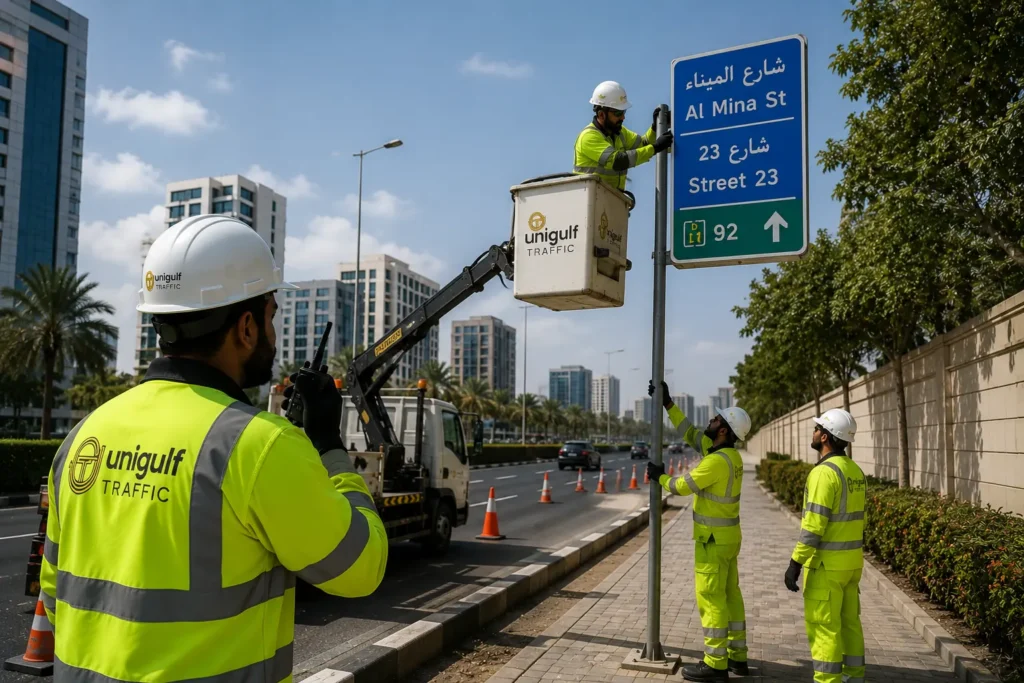
Traffic signage boards in Qatar are specified by the same manual as the road markings, so it makes sense to procure them from the same contractor. UniGulf Traffic supplies regulatory, warning, directional, informatory and site safety signs manufactured to the sizes, colours and retro-reflective sheeting grades used on Qatar roads, complete with posts, foundations, clamps and fixings, and installs them at the positions on your traffic management or signage drawing.
A sign is a system, not a board: the face sheeting grade determines how far it can be read at night, the substrate and frame determine whether it survives wind and vandalism, the post and foundation determine whether it is still upright after a summer, and the mounting height and offset determine whether it is legal and visible. We specify each element to the standard — aluminium substrate, reflective sheeting of the specified class, galvanised or powder-coated posts, concrete or driven foundations — and we set out each sign to the drawing so the sign faces the driver at the right distance.
Signage is delivered with road marking on new roads, compounds and car parks, and as a stand-alone package for temporary works, site safety and facility wayfinding.
Talk to a road marking engineer
Send the site location and any drawings. We survey free of charge and quote line by line, usually the same day.
What we do
Traffic signage scope
Permanent, temporary and site signage, supplied, fabricated and installed:
- Regulatory signs — stop, give way, no entry, speed limits, no parking, turn restrictions
- Warning signs — humps, crossings, bends, junctions, school zones, roadworks
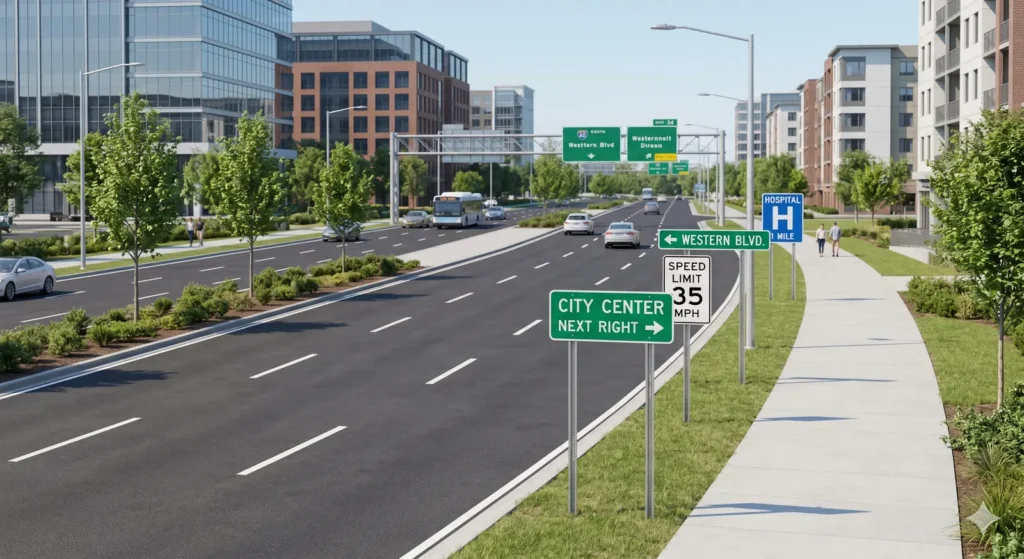
- Directional and destination signs, street name and route signs
- Informatory signs — parking, facilities, EV charging, accessible bays
- Car park signage — height bars, level and zone identification, exit and entry
- Site safety and construction signs — PPE, hazard, speed, traffic management
- Temporary traffic management signs and frames for lane closures
- Chevron boards, hazard markers, bollards and delineators
- Posts, sleeves, foundations, clamps and anti-theft fixings
- Sign face design to Qatar conventions, bilingual Arabic / English
- Installation, alignment and mounting to the specified height and offset
- Replacement and refurbishment of damaged or faded signs
Materials & specification
Sign construction and reflectivity
Sign faces are produced on aluminium substrate with retro-reflective sheeting of the class the specification requires — from engineering grade for low-speed internal roads to high-intensity prismatic grades for highways and directional signs that must be read at distance and at speed. Faces are printed or applied in Qatar standard colours and bilingual text, with edge protection and, where required, anti-graffiti overlay.
Posts are galvanised steel, painted or powder-coated as specified, set in concrete foundations or ground sleeves sized to the sign area and wind load. Clamps, brackets and tamper-resistant fixings complete the assembly. Sizes follow the standard for the road class — larger faces on faster roads — and mounting height and lateral offset follow the QTCM conventions.
| Substrate | Aluminium sheet, edge-framed for larger signs |
|---|---|
| Sheeting | Retro-reflective sheeting — engineering, high-intensity or prismatic grades as specified |
| Faces | Qatar standard shapes and colours; bilingual Arabic / English legends |
| Posts | Galvanised steel, painted or powder-coated; sizes to sign area and wind load |
| Foundations | Concrete footings or ground sleeves; driven posts for temporary signs |
| Fixings | Galvanised clamps and brackets; anti-theft and tamper-resistant fixings available |
| Sizes | To road class and the specification (larger on faster roads) |
| Mounting | Height and offset to QTCM conventions; aligned to face approaching traffic |
| Standards referenced | Ashghal / QTCM sign standards; QCS; project specification |
Where it is used
Where we supply and install signs
New roads and interchanges, residential and industrial compounds, car parks and basements, logistics yards and ports, schools and campuses, hospitals and hotels, construction sites and temporary traffic management schemes. Signs are usually procured together with thermoplastic road marking and road studs on public roads, and with car park marking on developments, so one contractor delivers the whole traffic package.
How we work
Our road marking process — survey to handover
Site visit & survey
An engineer measures the site, checks the surface condition, confirms the layout against your drawings or the QCS/Ashghal standard and agrees access, traffic management and working hours.
Setup & surface preparation
Traffic control is placed, old or faded lines are removed if required, and the surface is cleaned, dried and primed where the material specification calls for it.
Application
Markings are set out and applied with our own machines — thermoplastic, cold paint or MMA — with glass beads dropped on for retro-reflectivity and thickness checked during the run.
Inspection & handover
Dimensions, colour, thickness and reflectivity are checked, snags are closed the same visit, and you receive a handover with material data sheets for your submittal file.
Why UniGulf Traffic
A road marking contractor main contractors can rely on
Own equipment
Thermoplastic pre-heaters and screed applicators, airless spray line stripers, bead dispensers and removal equipment are ours — no waiting on hired plant.
Night-shift & closure windows
Crews are set up for lane closures, night works and airside or live-traffic sites where the marking window is a few hours, not a few days.
10+ years in Qatar
A decade of highways, car parks, airports and industrial sites in Qatar heat, dust and traffic — and the materials that survive it.
Itemised quotations
Every quotation is broken down by line type, length or area, material and mobilisation so QS teams can compare and approve it quickly.
Site conditions & price
Site conditions and what affects the price
Signs are quoted per unit — face, post, foundation and installation — by size and sheeting grade. Large directional signs on highways cost many times more than a compound speed-limit sign because of face area, prismatic sheeting, multi-post frames and foundations. Installation cost depends on ground conditions (excavation and concrete versus sleeves in paving), access, traffic management and the number of positions. Bilingual custom faces, anti-graffiti film and tamper-proof fixings add to the unit price but reduce replacement later.
What moves the price
- Sign size and quantity
- Sheeting grade — engineering vs high-intensity vs prismatic
- Post type, height and foundation (concrete vs sleeve)
- Custom bilingual faces and directional layouts
- Ground conditions and excavation
- Traffic management for installation on live roads
- Anti-graffiti and anti-theft options
- Combined package with line marking and studs
Related services
Often specified together
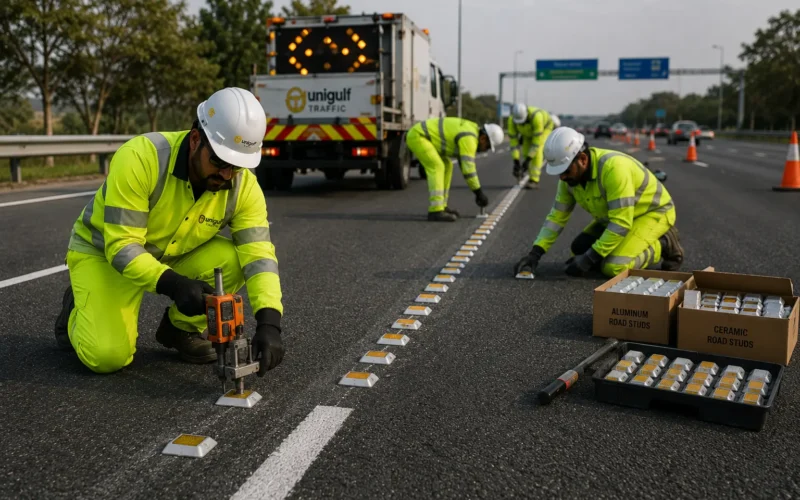
Road Studs
Reflective studs installed with the signs and lane lines.
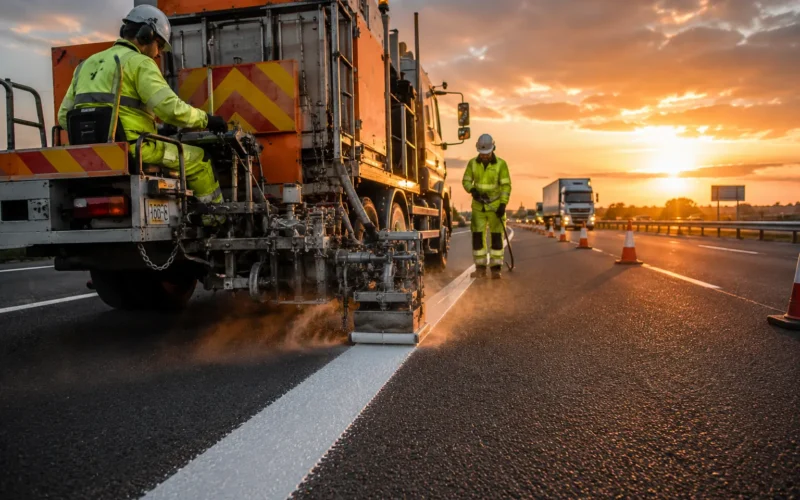
Thermoplastic Road Marking
Hot-applied road markings that the signs reinforce.
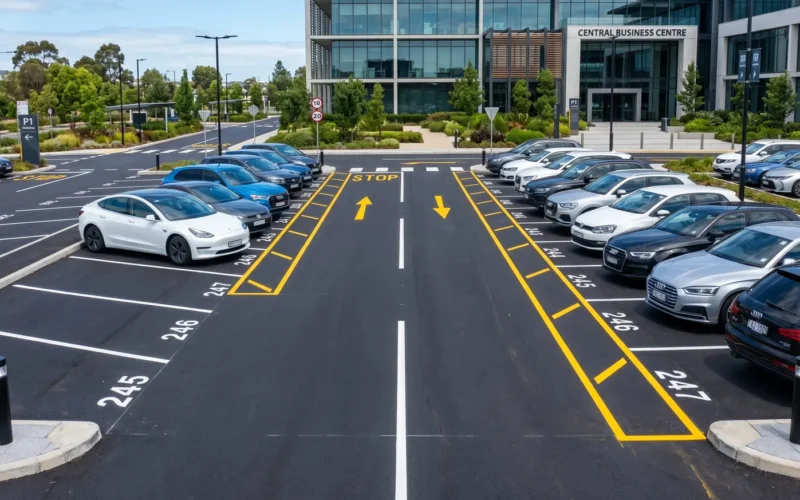
Car Park, Warehouse & EV Bay Marking
Bays, arrows and level signage for car parks and basements.
See all road marking services in Qatar or request a quotation for a combined scope.
FAQ
Traffic signage — FAQ
Questions we get from QS teams, consultants and facility managers. Anything else — call +974 5556 3941.
What reflectivity grade should a road sign have?
Are your signs bilingual?
Do you supply posts and foundations?
Can you provide temporary traffic management signs?
Do you design directional sign faces?
Can signs be installed with the road marking in one visit?
Free site visit · Same-day quotation
Need road marking in Qatar? Talk to an engineer today.
Send the site location, approximate area or number of bays and any drawings. We survey, confirm the specification and send an itemised quotation — usually the same working day.
Own crews & equipmentNight-shift capable10+ years in Qatar