
“How much per metre?” is the first question in almost every road marking enquiry in Qatar, and the honest answer is that the metre rate is the least important number in the quotation. Two contractors can quote the same rate for a 150 mm thermoplastic line and one of them will cost you twice as much by the end of the job. This guide explains how road marking is actually priced, what moves the price, and how to compare quotations so that the cheapest line rate does not become the most expensive contract.
How road marking is priced
Road marking in Qatar is quoted as a schedule of rates rather than a lump sum, because the quantities are rarely final when the price is needed. The usual units are:
- Per linear metre for lines, by width (100, 150, 200 mm), by material (acrylic paint, thermoplastic, MMA) and by thickness for thermoplastic (1.5, 2 or 3 mm).
- Per unit for arrows, symbols, legends, crossings, chevron blocks, road studs and signs.
- Per bay for car parks — the bay lines and the number, with accessible and EV bays priced separately.
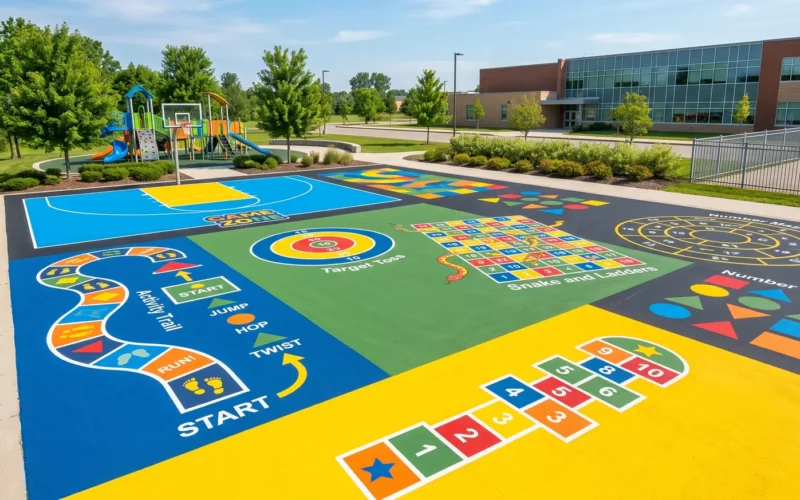
- Per square metre for coloured surfacing, anti-skid, hatching, epoxy flooring and playground surfacing.
- Per item or per shift for removal, surface preparation, traffic management, night working and mobilisation.
A quotation that shows only a line rate, with removal, preparation, traffic management and mobilisation folded in or left out, is not comparable with one that itemises them. Our quotations itemise everything — that is deliberate, and it is what QS teams tell us they want. Read our page on requesting a quotation for what we need to price accurately.
The materials, in order of cost
Acrylic cold paint is the cheapest material per metre by a wide margin: thin film, ambient application, fast. Hot-applied thermoplastic sits in the middle: the material is more expensive, the equipment is heavier and the crew is larger, but the line lasts several times longer. MMA cold plastic is the premium: the resin is expensive and coloured or anti-skid systems use a lot of it per square metre. As a rule of thumb the three sit roughly in the ratio of one to three to five or more per metre applied — though the ratio moves with line width, thickness and quantity. See thermoplastic vs cold paint for where each belongs.
The eight factors that move the price
1. Quantity and continuity
A crew that can lay two kilometres of continuous lane line in a night costs far less per metre than one setting out fifty short lines in a car park. Small, fragmented scopes carry a higher rate; large continuous scopes get the best rates.
2. Line width and thickness
Material is priced by volume. A 200 mm line uses twice the material of a 100 mm line; a 3 mm thermoplastic line uses twice the material of a 1.5 mm sprayed line. Specify what the standard requires, not more.
3. Symbols, arrows and legends
Every symbol is hand-set with a stencil or a template and applied by hand screed. Arrows, legends and crossings therefore cost far more per square metre than lines, and a junction with twenty arrows and four crossings can cost as much as the kilometre of lane line leading to it.
4. Surface condition and preparation
New, clean asphalt is the baseline. Aged or polished asphalt and concrete need priming for thermoplastic; dusty, oily or sandy surfaces need cleaning and degreasing; failed old coatings need removal. Each is an item on the quotation, and each is cheaper than a line that lifts in three months.
5. Removal of existing markings
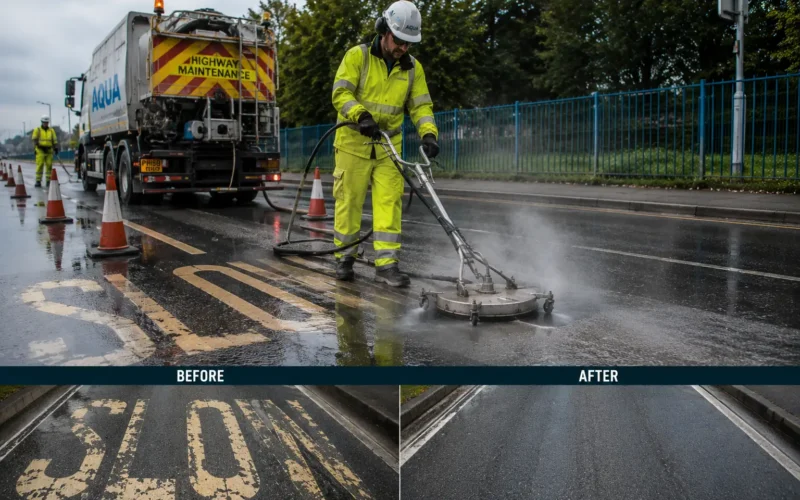
If the layout is changing, or old markings are worn through, they must be removed by water-blasting or grinding before re-marking. Removal is priced per metre and per square metre by material and can exceed the cost of the new line — thick thermoplastic and MMA take longer than paint. See line marking removal.
6. Traffic management, closures and night work
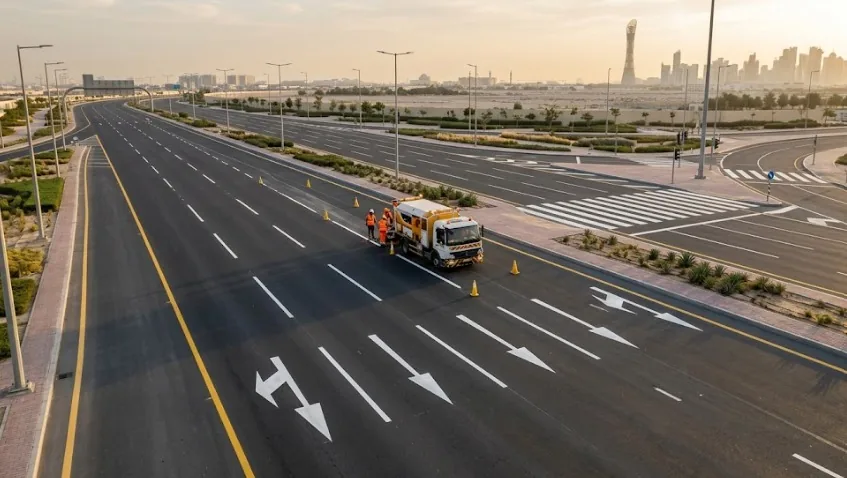
On a live road the marking crew is only part of the cost. Lane closures, traffic management equipment and staff, permits and night shifts are all priced separately and can be the largest items on a highway quotation. On a private site with no traffic, they disappear.
7. Location and mobilisation
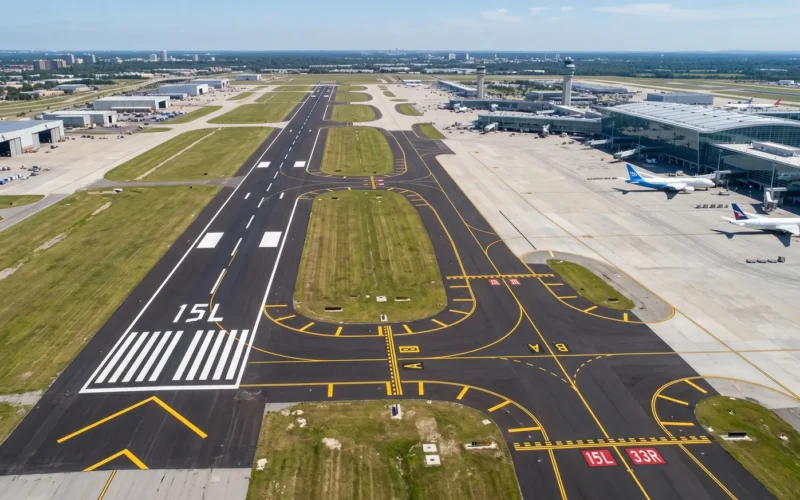
A site in Doha, Al Rayyan or Lusail is a short mobilisation; Ras Laffan, Mesaieed or Al Khor is a longer one, and airside or port sites add security and escort time. Mobilisation is usually a single item per visit, so combining scopes into one visit lowers the total.
8. Documentation and testing
Consultant submittals, inspection and test plans, trial panels, retro-reflectivity and skid-resistance testing and handover records take engineering time. They are normally included on public projects and priced as an item where a private client wants them — our submittal guide lists what is usually required.
Typical scopes and how they are priced
A 200-bay basement car park: priced per bay, plus per-unit arrows and symbols, plus aisle lines per metre, with concrete preparation as an item and night shifts if the car park is live. Material choice — acrylic versus epoxy line paint — is the main variable. See car park line marking.
A two-kilometre industrial road: priced per metre of thermoplastic by width, plus per-unit arrows, chevrons and crossings, plus road studs per unit, with traffic management and night work as items if the road is open.
A junction remodel: removal per metre and per square metre, MMA box junction and stop lines per square metre and per metre, thermoplastic lane lines per metre, plus closures — a scope where removal and traffic management can be half the value.
How to compare quotations properly
- Insist on the same schedule of rates from every bidder, with the same units.
- Check that removal, preparation, traffic management, night work and mobilisation are shown as items, not assumed.
- Check the material specification and thickness — a lower rate for a thinner line is not a saving if the specification calls for 3 mm.
- Ask what is included in handover: application records, data sheets, bead certificates, warranty.
- Ask whether the contractor owns the equipment. Hired plant means programme risk and, often, a hidden mobilisation charge.
The cheapest quotation for road marking is the one that does not have to be done twice. Send us the drawings and we will price it line by line, with everything shown.
Budgeting early
For feasibility, ask for budget rates by unit before the drawings are final, then firm them after the free site visit. The items that change most between budget and firm quotation are removal, surface preparation and traffic management, so a budget that shows them as provisional sums is more honest than one that omits them.
Frequently asked questions
How is road marking priced in Qatar?
As a schedule of rates: per linear metre for lines by width and material, per unit for arrows, symbols, crossings and studs, per bay for car parks, per square metre for coloured surfacing and epoxy, and per item for removal, preparation, traffic management and mobilisation.
Which is cheapest — paint, thermoplastic or MMA?
Acrylic paint is cheapest per metre, thermoplastic is mid-range and MMA cold plastic is the premium. Over the life of a busy road thermoplastic usually costs less than paint because it is not refreshed every year.
Why do quotations for the same job differ so much?
Usually because one itemises removal, preparation, traffic management and night work and the other leaves them out or folds them into the line rate. Compare on the same schedule of rates and check what is included.
Does a site visit change the price?
It makes it accurate. Surface condition, access, removal needs and traffic constraints cannot be judged from drawings, which is why our quotation follows a free site visit.
Do you charge for mobilisation?
Mobilisation is shown as an item per visit so it can be compared. Combining scopes — lines, studs, signs — into one visit reduces the total.
Get a free site visit and a same-day quotation
Send us the location, the approximate area or number of bays and any drawings you have. A UniGulf engineer will survey the site, confirm the material specification and send an itemised quotation — usually the same working day.