
Marking is usually the last activity on a road or car park programme, and the one squeezed hardest. The handover date is fixed, the surfacing finished late, and somebody assumes the lines can go down next week.
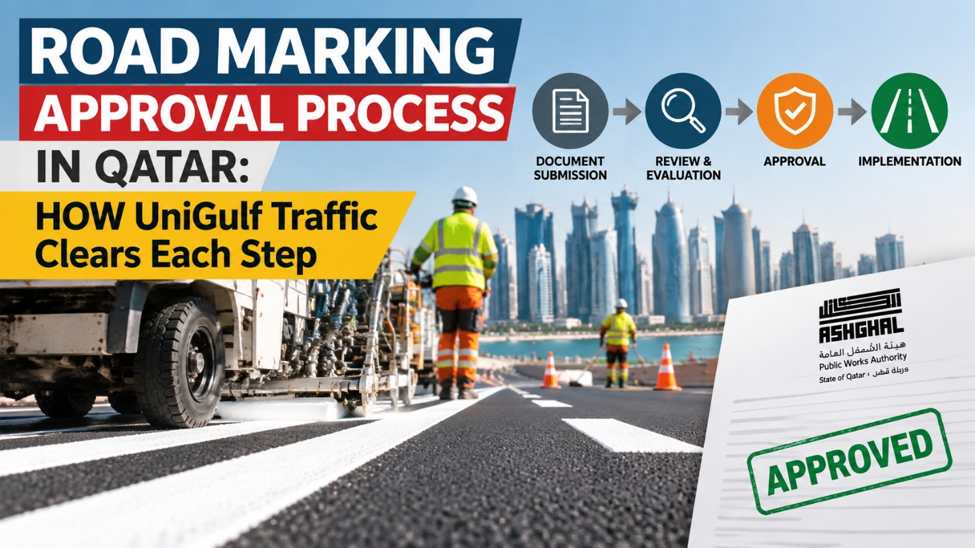
They can’t — not until the approvals are clear. The road marking approval process in Qatar runs on a sequence that cannot be skipped. At UniGulf Traffic we work through this sequence on every project, so this article sets out each step in the order it actually happens, and where the time is usually lost.
Step 1 — Subcontractor Nomination
The main contractor proposes the specialist firm to the consultant. On public works this is where prequalification status is checked, including whether the company appears on Ashghal’s Approved Vendor List for marking scope.
The nomination package normally carries the company profile, trade licence, certifications, equipment list, key personnel CVs and comparable project references.
As an Ashghal approved road marking company, UniGulf Traffic keeps this package current, so it can be issued the same day a contractor asks for it rather than assembled over a week.
Where it goes wrong: nominating a firm whose approval covers a different activity, or submitting an incomplete package and losing a full review cycle to resubmission.
Step 2 — Material Submittal
Next comes the material submission. The consultant checks that the proposed products meet the project specification, which on most road projects references the Qatar Construction Specifications (QCS).
Typically required: manufacturer data sheets, test certificates from a recognised laboratory, colour and durability details, glass beads specification for retroreflectivity, and product details for road studs where they form part of the scope.
UniGulf Traffic works with material systems that already carry the certification consultants expect, which avoids the delay that follows when a product has to be tested mid-project. Share your specification section early and we will confirm which system fits before anything is submitted.
Step 3 — Method Statement and ITP
The method statement describes how the work will be carried out: surface condition checks, cleaning and preparation, priming where required, setting out, application, and protection until the area is trafficable.
Alongside it sits the Inspection and Test Plan (ITP), setting out what gets checked, by whom, and at what stage. Two terms matter:
- A hold point stops work until the consultant inspects and releases it
- A witness point invites the consultant to attend, but work may proceed if they don’t
For marking, hold points commonly sit at surface acceptance and setting-out approval. UniGulf Traffic prepares both documents against the project’s own specification rather than issuing a generic template — consultants reject templates, and that rejection costs a review cycle.
Step 4 — Traffic Management Approval
Any work affecting live traffic needs a work zone traffic management plan prepared in line with the QTCM and approved before mobilisation.
On public roads this often involves an NOC and coordination with the relevant authorities, and marking frequently runs as night works to limit disruption. This step regularly takes longer than the material approvals, and it is the one most often left until last.
Our teams are set up for night working, so once the plan is approved we can mobilise to the window you have been given rather than asking for a different one.
Practical advice: start this in parallel with Step 2, not after it.
Step 5 — Setting Out and Trial Section
Before full application, the layout is set out and checked against the approved drawings. On larger or more sensitive projects the consultant may request a trial section — a short length applied to confirm appearance, thickness, adhesion and reflectivity before the rest proceeds.
UniGulf Traffic offers a trial section as standard on projects where finish is likely to be debated. A trial costs a few hours. Reapplying an entire car park because the colour, width or bead finish wasn’t what the consultant expected costs considerably more.
Step 6 — Application and In-Process Checks
During application, the checks that matter are the ones recorded: substrate temperature and dryness, material temperature for hot-applied systems, applied thickness, bead application rate, line width and alignment.
This is where a strong ITP earns its place. UniGulf Traffic crews record as they go, which produces a clean inspection file. A crew that fills the forms afterwards produces the file that gets queried.
Step 7 — Final Inspection, As-Builts and Handover
Final inspection covers line geometry against drawings, finish quality, and reflectivity readings where the specification calls for them. Once accepted, the closing documents follow — as-built drawings, material certificates, inspection records and any warranty documentation.
We issue the close-out pack with the completed works, because missing documents can hold up a project handover even when the physical work is finished and accepted.
How Long Should You Allow?
Durations vary with project type, consultant and authority workload, so treat this as a planning shape rather than a promise:
| Stage | Plan for |
| Subcontractor nomination | Longest when approval status has to be verified |
| Material submittal | Faster with locally certified, previously approved systems |
| Method statement and ITP | Usually quickest, if written against the actual spec |
| Traffic management and NOC | Frequently the critical path — start it first |
| Trial section | Short, but needs a consultant slot booked |
The pattern worth remembering: approvals that depend on external authorities take longer than approvals that depend on your consultant.
Five Things That Shorten the Timeline
- Bring the specialist in at a tender stage, not after the surfacing is finished.
- Confirm the specification clause references before choosing materials.
- Submit method statements, ITP and traffic management together rather than one after another.
- Book the consultant’s inspection slots in advance for hold points.
- Keep one document register so nobody is guessing which revision is current.
Why Contractors Bring UniGulf Traffic In Early
UniGulf Traffic is a Doha-based specialist in road marking and traffic safety works — thermoplastic and cold-applied marking, road studs, speed humps, parking layouts and traffic signage — on highways, local roads, car parks, airports, industrial facilities and commercial developments.
Because approval status, product certification and the standard submittal documents are already in place, the package for your consultant is assembled from existing records rather than built from scratch. That is usually where the first two weeks of a marking programme disappear.
Send us the project name, specification section and target handover date, and we will map the approval steps against your programme before you commit to a date you can’t hold.
Frequently Asked Questions
How long does the road marking approval process in Qatar take?
It depends on the project type, the consultant and authority workload. Stages involving external authorities — particularly traffic management approvals — are normally the longest, so start those first.
Who submits the road marking documents, the main contractor or the subcontractor?
The specialist prepares them; the main contractor submits them to the consultant. UniGulf Traffic issues documents in the format contractors can forward without reworking.
What is a hold point in a road marking ITP?
A stage where work must stop until the consultant inspects and releases it. Surface acceptance and setting-out approval are common examples.
Is a trial section always required?
No. It depends on the consultant and the project’s sensitivity, but it is a low-cost way to settle any question about finish or colour before full application.
Can marking start before traffic management approval?
Not on live roads. Work affecting traffic requires an approved plan, and on public roads usually an NOC, before mobilisation.
Focus Keyword: road marking approval process in Qatar
SEO Title: Road Marking Approval Process in Qatar | UniGulf Traffic
Meta Description: UniGulf Traffic explains the road marking approval process in Qatar — nomination, material submittals, ITP hold points and inspection, in the order they happen.
URL Slug: road-marking-approval-process-in-qatar
Secondary Keywords: Ashghal approved road marking company, thermoplastic road marking company
LSI Keywords (all used in body, bolded): consultant, main contractor, subcontractor nomination, material submittal, method statement, Inspection and Test Plan (ITP), hold point, witness point, Qatar Construction Specifications (QCS), QTCM, prequalification, Approved Vendor List, trial section, glass beads, retro reflectivity, road studs, work zone traffic management, night works, NOC, as-built drawings
Get a free site visit and a same-day quotation
Send us the location, the approximate area or number of bays and any drawings you have. A UniGulf engineer will survey the site, confirm the material specification and send an itemised quotation — usually the same working day.