
Six months after a project hands over, a maintenance team is out collecting studs from the hard shoulder. They weren’t hit by vehicles. They came off because of how they were fixed, or because the wrong type was specified for that location in the first place.
Road studs installation in Qatar is a small line item on most projects and one of the most frequently redone. The studs themselves rarely fail. The fixing method, the surface preparation and the type selection do. This article covers how to get those three right.
What Road Studs Actually Do
Known on site as cat eyes, road studs give drivers guidance when the painted line is hard to read — at night, in rain, in blowing dust, or where street lighting is absent.
Their main functions:
- Lane delineation where lighting is poor or absent
- Edge and median definition on open roads
- Hazard warning ahead of bends, merges and junctions
- Supporting marking on ramps, speed humps and car park routes
They are a supplement to marking, not a replacement for it. Studs placed where the line itself is failing solve the symptom and leave the cause.
Recessed or Surface-Mounted?
This is the first decision, and it decides most of what follows.
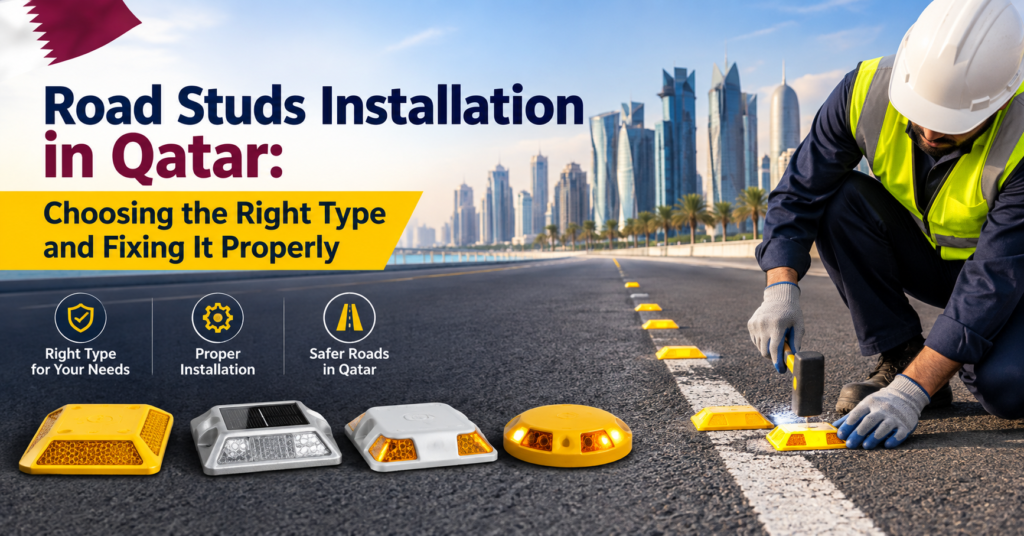
Recessed studs sit in a pocket cut into the pavement, with the body below the surface and only the lens exposed. Because vehicles pass over them rather than striking the side, they survive heavy traffic and sweep far better. Installation is slower — the pocket has to be cut by core drilling or a cutting head, cleaned and dried.
Surface-mounted studs are bonded onto the finished surface. Installation is fast and cheap, which is why they are the default on car parks and lower-speed roads. On high-speed carriageways they take the full impact of every vehicle that clips them, and that is where they come loose.
A simple rule: the more traffic and the higher the speed, the more the recessed option earns its cost.
Adhesive Choice Matters More Than People Think
Most stud failures are bond failures.
Epoxy adhesive gives a strong, rigid bond and is commonly used where loading is heavy. It needs correct mixing and a properly prepared surface, and it has a working time that has to be respected.
Bitumen adhesive is applied hot and bonds well to asphalt. It is more tolerant of slight surface irregularity and often faster on long runs.
Either way, the controlling factor is surface preparation. Dust, moisture, oil or loose material under a stud will defeat any adhesive. Installing onto a surface that was swept but not dried is one of the most common reasons studs appear in the gutter a few weeks later.
Reflective or Solar?
Reflective road studs are passive. They return light from headlamps through the lens, needing no power and no maintenance beyond staying clean and intact.
Solar road studs emit their own light, which makes them visible from much further away and effective in fog or heavy rain. They cost more, contain electronics and batteries that age, and need a maintenance route when a unit stops working.
Solar units suit specific situations — unlit stretches, hazardous bends, pedestrian crossings on dark roads — rather than general use along an entire alignment. Before specifying them, ask who will replace a failed unit in three years and whether that budget exists.
Colours and Placement Are Not Free Choices
Stud colour carries meaning. Different colours indicate different functions — lane separation, edges, slip roads and particular hazards — and the convention that applies to your project is set out in the approved drawings and in the specification, typically referencing QCS on public work in Qatar.
Spacing is also specified, and it usually tightens through hazard areas. Both colour and spacing are setting out decisions taken from the drawings, not matched to whatever was there before. Where a layout has been revised, the previous positions are not a reliable guide.
Why Studs Fail Early
- Installed on a damp or dirty surface. The bond never develops properly.
- Surface-mounted studs used at high speed. Repeated impact works them loose.
- Pocket not cleaned on recessed installation. Debris prevents the stud seating flat.
- Adhesive applied outside its working window. It skins over before the stud is set.
- Lens left dirty or scratched. The stud stays in place but the retroreflectivity disappears, which is the only reason it was installed.
Questions to Ask Before Installation
- Recessed or surface-mounted, and why that choice for this location?
- Which adhesive is proposed, and is the surface being dried before installation?
- What is the specified spacing and colour arrangement for this section?
- How long before traffic can run over them?
- For solar units, what is the maintenance and replacement arrangement?
- Is the work zone arrangement approved for the planned hours?
Maintenance Nobody Budgets For
Studs need two things over their life: to stay bonded, and to stay visible.
A quick annual check — driven at night, not walked in daylight — will show which units have gone dark long before anyone reports them. Replacing a handful of studs on an existing closure is routine. Discovering that an entire stretch has lost night visibility during an inspection is not.
Where UniGulf Traffic Fits
UniGulf Traffic is an Ashghal approved road marking company based in Doha, working on highways, local roads, car parks, airports, industrial facilities and commercial developments across Qatar.
Road stud installation in Qatar is usually carried out alongside marking in the same mobilisation, which avoids a second closure and keeps the setting out consistent between the lines and the studs. If you are specifying studs for a new alignment or replacing units that have come loose, the team can advise on type and fixing method for that surface.
Send the location, the drawing extract and the surface type, and the team will come back with a recommendation.
Frequently Asked Questions
What is the difference between recessed and surface-mounted road studs?
Recessed studs sit in a pocket cut into the pavement, so vehicles pass over them rather than striking them, which suits high-speed and heavy traffic. Surface-mounted studs are bonded onto the finished surface — faster and cheaper, better suited to car parks and lower-speed roads.
Why do road studs come loose?
Almost always a bond problem: the surface was damp, dusty or oily at installation, the adhesive was used outside its working time, or a surface-mounted stud was used where impact loading is too high.
Are solar road studs worth the extra cost?
In specific locations — unlit stretches, sharp bends, crossings on dark roads — they add real visibility. Across a whole alignment they are rarely justified, and they need a maintenance route for failed units.
What do the different road stud colours mean?
Each colour indicates a particular function such as lane separation, edges or specific hazards. The arrangement that applies is stated in your project’s approved drawings and specification.
How far apart should road studs be placed?
Spacing comes from the specification and drawings and usually tightens through hazard areas. It is not set on site.
How soon can traffic run over newly installed studs?
It depends on the adhesive and conditions, and should be confirmed before the closure is planned so the road reopens on schedule.
Get a free site visit and a same-day quotation
Send us the location, the approximate area or number of bays and any drawings you have. A UniGulf engineer will survey the site, confirm the material specification and send an itemised quotation — usually the same working day.