
Most facility and project managers only think about road marking twice: once when the lines are first applied, and again when they have faded so badly that a client or an authority complains. Between those two moments sits a cost that rarely appears in the original budget — repainting.
If you have already repainted the same car park or access road two or three times in a few years, the problem usually isn’t the contractor. It’s the material. This article explains where that money actually goes, and why the more expensive option at the start is often the cheaper one by year five.
Why Cheap Marking Gets Expensive
Cold paint markings are thin. It sits on the surface as a coating, typically a fraction of a millimetre thick, and it wears through wherever tyres cross it repeatedly — entrances, junctions, ramps, loading bays.
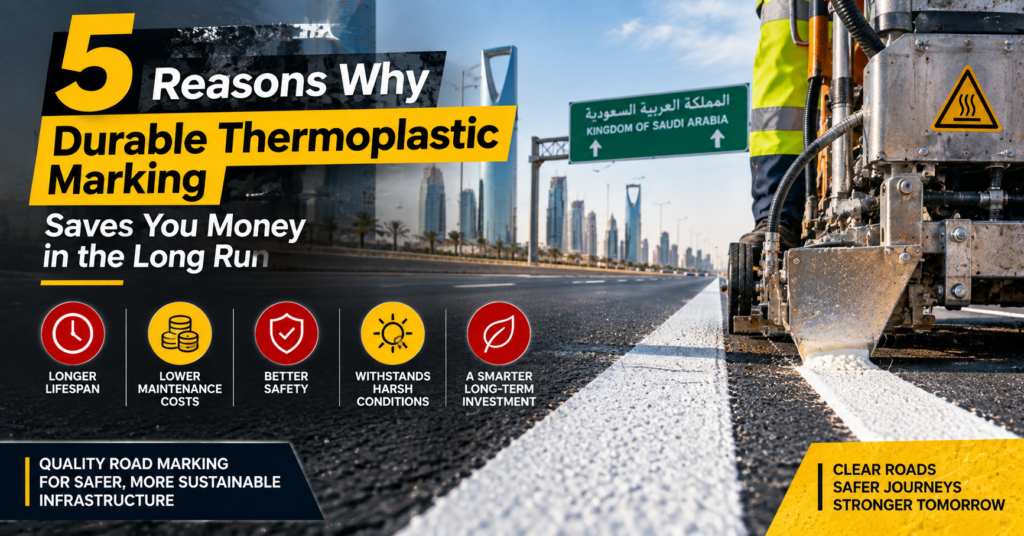
Thermoplastic is a different product entirely. It is heated and applied as a molten material that bonds into the surface and cures into a hard layer several millimetres thick, with glass beads embedded for night-time reflectivity.
In Qatar’s climate, that difference matters more than it does elsewhere. Surface temperatures, UV exposure, sand abrasion and heavy vehicle traffic all attack a thin coating far faster than they attack a thick bonded one.
1. Fewer Repainting Cycles
This is the largest saving and the easiest to calculate. Every repainting cycle costs you materials, labour, mobilisation and supervision time. If a thinner marking needs renewal noticeably more often than thermoplastic on the same surface, you are paying that full cycle cost again each time.
Ask any road marking company in Qatar for the expected service life of each option on your specific surface and traffic load, then compare total spend over five years — not the price per square metre on day one.
2. Less Operational Disruption
Closing a car park bay, a warehouse yard or a section of access road has a cost even when the marking itself is cheap. Tenants complain, deliveries reroute, and someone on your team spends a day managing it.
Longer-lasting marking means fewer closures. For live sites — malls, logistics yards, hospitals, industrial facilities — this is often the saving that management notices first.
3. Better Night-Time Visibility for Longer
Retroreflectivity comes from glass beads. In thermoplastic, beads are both mixed into the material and dropped onto the surface during application, so as the top layer wears, fresh beads are exposed.
Practically, this means the marking stays readable at night deeper into its life. That reduces the chance of an incident on your property, and incidents are far more expensive than any marking contract.
4. Fewer Compliance and Handover Problems
Faded or inconsistent markings get flagged during inspections, audits and project handovers. Rectification work at that stage is always urgent, always disruptive, and rarely priced favourably.
Durable marking applied correctly the first time removes a recurring item from your snag list.
5. The Surface Underneath Lasts Better Too
Repeated preparation, scraping and removal of old marking is not kind to asphalt or concrete. Reducing how often that happens protects the substrate you have already paid for.
Important Issues to Consider When Hiring a Contractor
Material alone doesn’t guarantee durability. Application does. Before awarding the work, ask:
- How will the surface be cleaned and prepared before application?
- What thickness is being applied, and is it stated in the quotation?
- Are glass beads included, and how are they applied?
- Is a primer being used, and on which surface types?
- What traffic conditions is the proposed system suited to?
- How long must the area stay closed after application?
A contractor who answers these clearly is a contractor who understands why marking fails.
When Cold Paint Still Makes Sense
Thermoplastic is not automatically the right answer. Temporary diversions, short-term site layouts, low-traffic internal areas and markings you expect to change soon are all reasonable cases for cold paint. The point is to match the material to how long the marking actually needs to survive.
Working With UniGulf Traffic
UniGulf Traffic provides road marking, traffic safety, signage and infrastructure solutions across Qatar, including thermoplastic road marking, cold paint marking, parking lot marking, traffic signs, road studs and speed humps. Work covers highways, roads, parking areas, airports, industrial facilities and commercial developments.
If you are comparing options for a specific site, the useful next step is a site-specific recommendation rather than a generic quotation.
Contact: +974 5556 3941 | operations@unigulfems.com
Frequently Asked Questions
How long does thermoplastic road marking last compared to cold paint?
Service life depends on traffic volume, surface condition and application quality. Thermoplastic is applied far thicker than cold paint and bonds into the surface, so it generally requires renewal less often. Ask your contractor for an estimate based on your actual site conditions.
Is thermoplastic marking more expensive than paint?
The initial cost per square metre is higher. The comparison worth making is total cost over several years, including repeated repainting, mobilisation and site disruption.
Can thermoplastic be applied over existing markings?
Existing markings usually need to be removed or prepared first. Applying over failing material transfers that weakness to the new layer.
How soon can traffic use the area after application?
Thermoplastic cures quickly once applied, so reopening times are typically short. Confirm the specific timing with your contractor, as it varies with ambient conditions and thickness.
Does thermoplastic work in Qatar’s summer heat?
Yes — it is widely used across the region. Application timing and surface temperature still need to be managed properly, which is part of what a specialist contractor controls.
What surfaces can it be applied to?
It is commonly applied to asphalt and concrete. Concrete usually requires a primer for proper adhesion.
Which is better for car parks?
It depends on traffic and how permanent the layout is. Busy commercial car parks with fixed layouts usually justify thermoplastic; temporary or frequently changing layouts may not.
Get a free site visit and a same-day quotation
Send us the location, the approximate area or number of bays and any drawings you have. A UniGulf engineer will survey the site, confirm the material specification and send an itemised quotation — usually the same working day.