
Every road marking enquiry we receive in Qatar eventually comes down to one question: thermoplastic or cold paint? The two materials look the same on the drawing — a 150 mm white line is a 150 mm white line — but they behave completely differently under traffic, sun and sand, and they are priced completely differently. This guide explains how the two systems work, where each one is the correct specification, and how to decide when the drawing is silent.
What hot-applied thermoplastic actually is
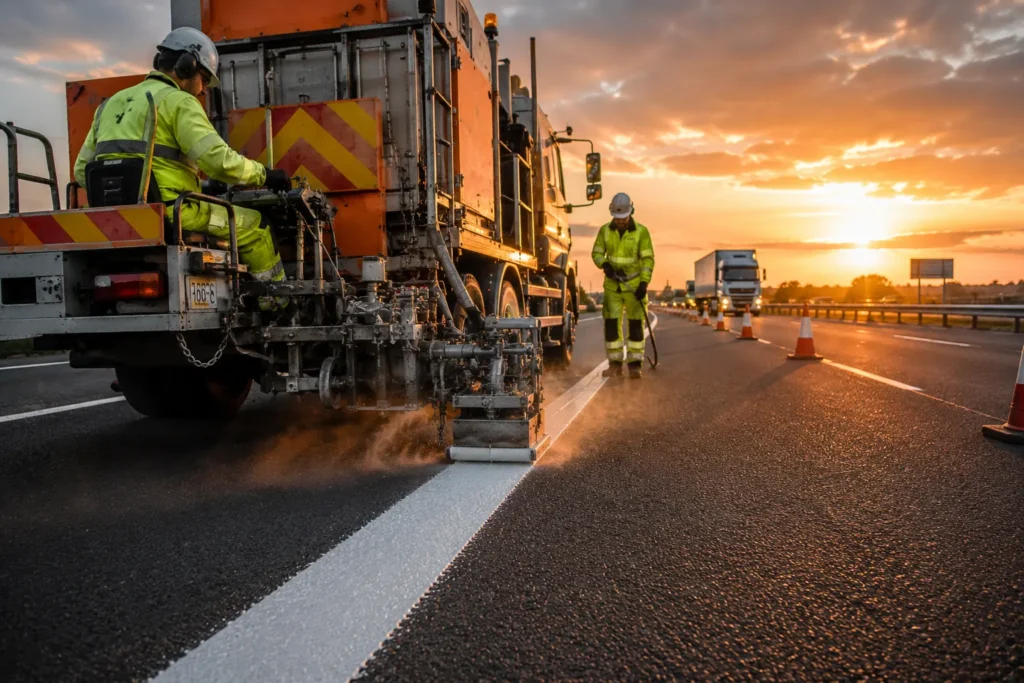
Thermoplastic road marking material is a dry blend of resin (alkyd or hydrocarbon), pigment, mineral filler and glass beads. On site it is melted in a pre-heater at roughly 180–220 °C and laid onto the road as a molten line through a screed box, an extrusion die or a spray gun. As it cools it solidifies within minutes into a raised, wear-resistant profile that is typically 2–3 mm thick for screed and extruded lines and around 1.5 mm for sprayed lines. Additional glass beads are dropped onto the hot surface as it is laid, so the line is retro-reflective from day one, and the intermixed beads keep it reflecting as the surface wears down.
That thickness is the reason thermoplastic lasts. A paint line is a thin film that abrades away; a thermoplastic line has depth to lose before it stops working. On Qatar highways, where a lane line may take many thousands of tyre passes a day, that difference is measured in years. Our thermoplastic road marking page covers the material specification and standards in more detail.
What cold paint is
Cold-applied road paint — usually a water-based acrylic in Qatar today, sometimes a solvent-based chlorinated rubber or alkyd where a specification calls for it — is applied by airless spray at a wet film of around 300–400 microns, less than half a millimetre. Glass beads are dropped on while the paint is wet. It dries to touch in 10–30 minutes and takes traffic within an hour. It costs a fraction of thermoplastic per metre, is quick to apply, is low-odour indoors and is easy to refresh without removing the old line.
The trade-off is life. Under heavy traffic the film wears through in months; on a lightly used internal road or in a car park it can last for years. See acrylic road marking in Qatar for the full specification.
The comparison in numbers
| Criterion | Hot-applied thermoplastic | Acrylic cold paint |
|---|---|---|
| Thickness | 2–3 mm screed / extrusion; ~1.5 mm spray | 0.3–0.4 mm wet film |
| Application | Melted at 180–220 °C; screed, extrusion or spray | Airless spray at ambient temperature |
| Reopening | Sets in 2–10 minutes; traffic in ~15 minutes | Touch-dry 10–30 minutes; traffic in ~1 hour |
| Reflectivity | Intermixed and drop-on beads; keeps reflecting as it wears | Drop-on beads only; reflectivity falls as the film wears |
| Typical life in Qatar | Several years on main roads | Months on busy roads; years on light-use sites |
| Cost per metre | Mid | Lowest |
| Best for | Highways, main roads, roundabouts, crossings, arrows | Internal roads, compounds, car parks, cycle lanes, temporary works |
Where thermoplastic is the correct specification
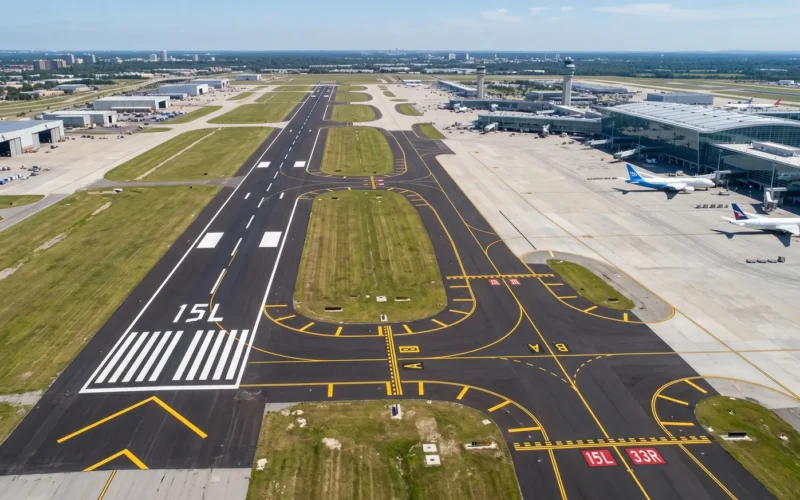
Public roads. If the road is an expressway, an arterial, an interchange, a roundabout, a signalised junction or a pedestrian crossing, the specification will almost always be hot-applied thermoplastic, and for good reason: the line has to survive years of traffic between maintenance visits and remain visible at night. Qatar Construction Specifications (QCS) and Ashghal conventions treat thermoplastic as the standard material for permanent carriageway markings, referencing standards such as BS 3262 or AASHTO M249 for the material and BS 6088 or AASHTO M247 for the glass beads.
Thermoplastic is also the right call on private roads that behave like public ones — industrial estate roads carrying trucks, port and logistics access roads, airport landside roads — and for any client who would rather pay once than refresh paint every year.
Where cold paint is the correct specification
Everywhere the traffic is light and the priorities are cost, speed and a clean finish: residential compound roads, private internal roads, mall and office car parks, school drop-off zones, hospital and hotel parking, cycle lanes on paths, and temporary layouts during construction. Cold paint is also the natural choice for maintenance re-marking of an existing painted layout, because it goes straight over the old line without removal.
There is one more case: basements and covered car parks. Water-based acrylic is low-odour and low-VOC, which matters in an occupied building. Thermoplastic in a basement means fumes, a pre-heater and a fire watch — rarely worth it.
What about MMA cold plastic?
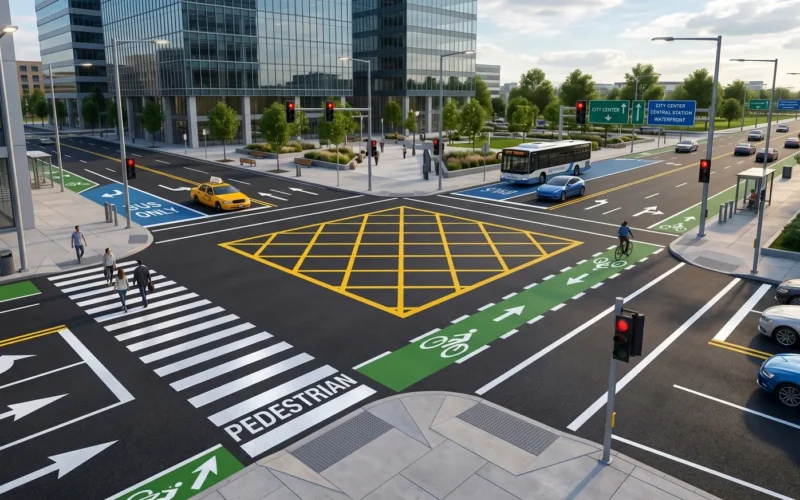
There is a third option that sits above both: two-component methyl methacrylate, or MMA cold plastic. It is cold-applied like paint but laid thick like thermoplastic, cures chemically in 20–40 minutes, bonds to concrete, holds colour for years and takes an anti-skid aggregate. It is the specification for yellow box junctions, coloured bus and cycle lanes, high-friction surfacing on approaches and ramps, and bridge decks. It costs more than thermoplastic, so it is used at the points on the road where lines take the most punishment rather than for kilometres of lane line.
How to decide when the drawing is silent
Ask three questions. How much traffic, at what speed? Heavy or fast traffic means thermoplastic. How quickly must the surface reopen, and how often can you come back? If a refresh every year or two is acceptable and the budget is tight, paint. Is the surface asphalt or concrete? Thermoplastic bonds well to asphalt but needs a primer on concrete; paint and MMA bond to both. Then check the surface condition: new asphalt should cure before thermoplastic is applied, and old polished asphalt or dusty concrete needs preparation whichever material you choose.
If the project has a consultant, the answer is in the specification and the submittal will be reviewed against it — our approved vendor and submittal guide explains what the reviewer looks for. If it does not, send us the drawings and we will recommend the material line by line and quote both options.
Common mistakes we are asked to fix
- Paint on a highway. It looks fine on handover day and is gone by the second summer. The cost of re-marking under a lane closure is far higher than the saving.
- Thermoplastic on unprimed concrete. The line lifts in sheets. Prime it, or use MMA.
- No beads. A line with no glass beads is invisible under headlights. Beads are not optional on any road.
- Marking new asphalt too early. Oils in fresh asphalt can bleed through and stop the material bonding. Allow the curing period the paving contractor and material supplier advise.
- Over-marking a wrong layout. Old lines must be removed, not painted over — see line marking removal.
The short version: thermoplastic for roads, paint for car parks and compounds, MMA where the line takes the most stress. Get the surface preparation and the beads right, and any of the three will perform.
A rule of thumb for mixed sites
Most real projects need both materials. A logistics compound, for example, takes thermoplastic on the truck route, the weighbridge approaches and the crossings, acrylic paint on the staff car park and internal circulation, and MMA at the gatehouse stop line and the loading dock hatching that forklifts cross all day. Specifying by location rather than by site is what keeps the cost proportionate and the maintenance cycle sensible.
Frequently asked questions
Which lasts longer in Qatar, thermoplastic or paint?
Thermoplastic, by a wide margin on busy roads. A 2–3 mm thermoplastic line typically gives several years of service where a paint film may wear through within a year. On lightly used car parks the gap narrows and paint can last for years.
Is thermoplastic always more expensive?
Per metre applied, yes — but over the life of a busy road it is usually cheaper because it is not refreshed every year, and each refresh on a live road carries traffic management costs.
Can cold paint be applied over thermoplastic?
It can be, but the paint will wear off the raised thermoplastic profile quickly. Refresh thermoplastic with thermoplastic; refresh paint with paint.
Which material for a basement car park?
Water-based acrylic paint, or an epoxy or polyurethane line paint on coated concrete. Thermoplastic in a basement involves fumes and a pre-heater and is rarely specified.
What does QCS say about road marking material?
QCS sets requirements for road marking materials, glass beads and application and references international standards for each product type. Thermoplastic is the standard material for permanent carriageway markings on public roads; the exact clauses to follow are those cited in your project specification.
Get a free site visit and a same-day quotation
Send us the location, the approximate area or number of bays and any drawings you have. A UniGulf engineer will survey the site, confirm the material specification and send an itemised quotation — usually the same working day.