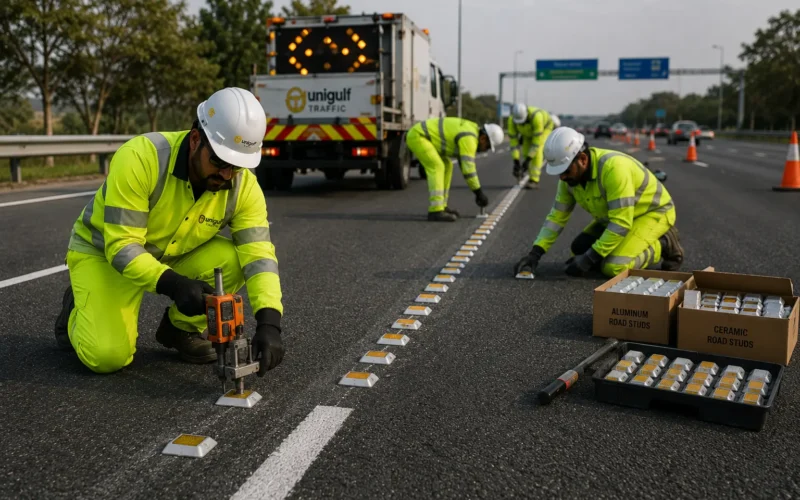

Everything about marking an airport is normal road marking with one variable removed: time. A runway or taxiway closure is measured in hours, it was negotiated months in advance, and if the crew is not off the pavement with the markings complete and inspected when the window closes, the consequences reach a long way beyond the marking contract. This article explains how airport runway marking is planned and executed inside airside closure windows — the permits, the set-out, the materials and the sequencing — based on how we run airside works. For the service, see airport and runway marking in Qatar.
What is being marked
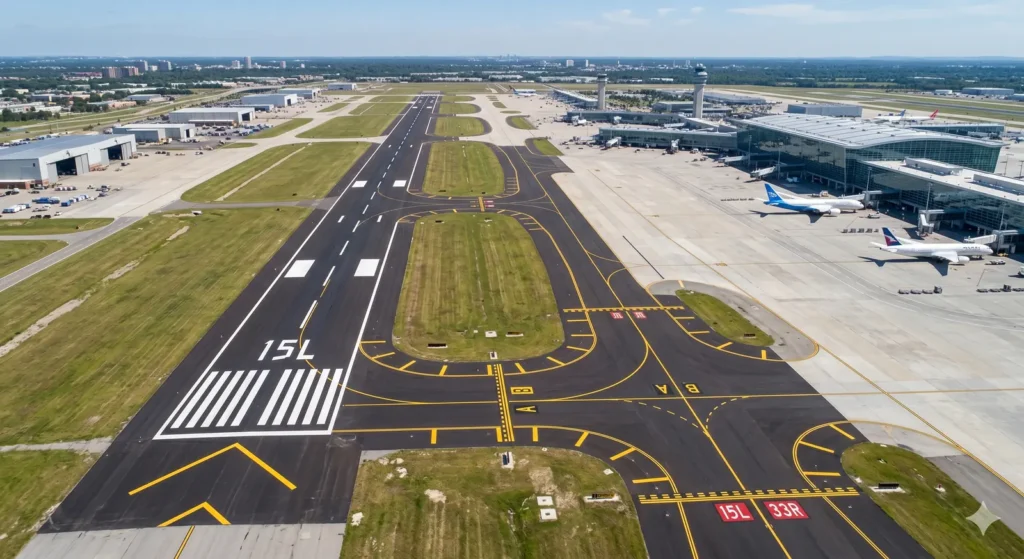
Airfield markings follow international conventions, with the airport authority’s standards based on ICAO Annex 14 and the Aerodrome Design Manual, and the specific geometry taken from the airport’s approved drawings. On the runway: threshold bars, designation numbers, centreline, touchdown zone and aiming point markings, side stripes and, where used, displaced threshold arrows — all white. On taxiways: centrelines, edge lines, intermediate and runway holding position markings and enhanced centrelines — yellow. On aprons: stand lead-in lines, stop bars, stand numbers, equipment restraint and safety lines, service roads and vehicle corridors — yellow, white and red. Every dimension and every offset is specified, and every one is inspected before the pavement is released.
Before the closure: the planning that decides the night
Permits and clearances
Airside work needs airport passes and inductions for every crew member, vehicle permits for every piece of plant, a works permit for the closure and, usually, an escort from airside operations. These take weeks, so the crew list and the equipment list are fixed early and do not change. A crew member without a pass does not work; a vehicle without a permit does not enter.
Method statement and drawings
The method statement states what will be marked, in what material, at what thickness and bead rate, in what sequence, with what equipment and how the surface will be prepared. The drawings are the approved marking layout with set-out coordinates. Both are reviewed and approved before the closure, together with the inspection plan that will release the pavement.
Material and equipment
The material is whatever the specification names: hot thermoplastic for durable lines on asphalt, MMA cold plastic where fast cure and fuel resistance matter (aprons, concrete), or airfield-grade acrylic paint where the standard calls for it. All material is on site, pre-batched, with data sheets in the file. Equipment is checked the day before — a pre-heater that fails at 2 a.m. cannot be fixed inside the window — and everything is loaded so it moves through the airside gate in one convoy.
FOD control
Foreign object debris is the airside obsession. Every tool, bead bag, stencil, cone and mixing pot is counted onto the pavement and counted off. Vehicles are checked for loose items. Sweeping and a final FOD walk are part of the programme, not an afterthought.
Inside the closure: sequence
- Mobilise as one movement. The convoy enters the airside gate at the start of the window with the escort and drives to the work area by the approved route.
- Surface preparation. Rubber deposits and old markings are removed by high-pressure water-blasting with vacuum recovery; the pavement is swept and blown. On concrete a primer is applied where the material requires it. See line marking removal.
- Set-out. Positions are set out with total-station or laser control from the drawing coordinates and checked against the existing markings and the pavement edges. Errors are found now, not at inspection.
- Application. Lines are applied by machine, numbers and symbols by hand screed and template, beads are dropped at the specified rate, and thickness is checked during the run. Large runway designators are applied in sections with the crew working in parallel.
- Cure and inspect. Thermoplastic sets in minutes; MMA in 20–40 minutes; paint in 30–60. Dimensions, colour, thickness and bead coverage are inspected with the airport’s representative and recorded.
- FOD walk and demobilise. Everything is counted off, the pavement is swept and walked, and the convoy leaves with the escort before the window closes, with margin.
Sizing the crew for the window
The mistake is to size the crew for the quantity and hope. Airside crews are sized for the window: enough people and machines to finish with a margin, because the cost of an extra crew is small next to the cost of an overrun. Long runway work is split into sections that can each be completed and inspected within a single closure, so a night lost to weather loses one section, not the whole job.
Materials on aprons
Aprons are different from runways: the pavement is often concrete, the traffic is slow but heavy, and the surface sees jet fuel, hydraulic fluid and de-icing agents. MMA cold plastic bonds to concrete, cures fast and resists fuels, which is why it is often specified for stand markings; airfield paint is used where frequent refresh is expected. Stand lead-in lines and stop bars are dimensioned to the aircraft types the stand serves, and a stand marked to the wrong geometry is a stand that cannot be used. See when MMA is worth it.
Landside
The same contract usually includes landside roads, drop-off lanes and car parks, which are marked in thermoplastic and paint under ordinary traffic management — a simpler job, but scheduled around the terminal’s peaks.
What the airport gets at handover
A marking record for each closure: what was applied where, material batches, temperatures, thicknesses, bead rates, inspection sign-offs and photographs; data sheets and certificates for the quality file; and, where required, retro-reflectivity readings. That file is what lets the airport prove its markings comply — and it is what we build the closure plan to produce.
A closure night, hour by hour
A representative taxiway closure of six hours runs like this. Hour one: convoy through the airside gate with the escort, tools and materials counted onto the pavement, the work area coned, and water-blasting of rubber deposits and the old edge lines begun at the far end. Hours two to four: set-out with the total station from the drawing coordinates, checked against the existing centreline; screed application of the new yellow centreline and edge lines with beads dropped on, thickness checked every 50 m; holding position markings and the enhanced centreline pattern by hand template. Hour five: cure, inspection with the airport representative, dimensions and colour checked, any snags closed. Hour six: FOD walk, sweeping, tool and material count off the pavement, convoy out with the escort, pavement released with a margin. The record for the night — what was applied, batches, temperatures, thicknesses, bead rates, inspection sign-off and photographs — is issued the next morning. Every night follows the same shape; what changes is the section.
Weather and contingency
A wet pavement, blowing sand or an operational change can cancel a closure at short notice. The contingency is built into the sectioning: no section is started that cannot be finished and inspected inside the window, materials are held for the next available night, and the crew is released rather than left waiting on the apron.
Frequently asked questions
What standards do airport markings follow?
The airport authority’s standards, which are based on ICAO Annex 14 and the Aerodrome Design Manual, with the specific geometry taken from the airport’s approved drawings and the project specification.
How long is a typical runway closure for marking?
Closures are usually a few hours at night. Work is split into sections that can each be completed and inspected inside a single closure, and crews are sized to finish with a margin.
What material is used for runway markings?
Whatever the specification names: hot thermoplastic for durable lines on asphalt, MMA cold plastic where fast cure and fuel resistance matter, or airfield-grade paint where the standard calls for frequent refresh.
What is FOD control?
Foreign object debris control — counting every tool and material onto and off the pavement, checking vehicles and sweeping and walking the area before release, so nothing is left that could damage an aircraft.
Do crews need special clearance for airside work?
Yes — airport passes and inductions for every person, permits for every vehicle and a works permit for the closure, arranged with the airport authority weeks in advance.
Get a free site visit and a same-day quotation
Send us the location, the approximate area or number of bays and any drawings you have. A UniGulf engineer will survey the site, confirm the material specification and send an itemised quotation — usually the same working day.