
MMA cold plastic is the most expensive road marking material we apply, and in the right place it is also the cheapest — because it is the only one that does not have to be redone. The trick is knowing which places those are. This article explains what MMA is, what anti-skid surfacing adds, where the extra cost pays back within the life of the road and where a thermoplastic or painted line would have been the sensible choice. For the service, see MMA cold plastic marking in Qatar.
What MMA cold plastic is
Methyl methacrylate cold plastic is a two-component resin system: a pigmented base containing filler and, where required, aggregate, mixed on site with a peroxide hardener (usually benzoyl peroxide) that starts a chemical cure. There is no heat and no solvent; the material goes on cold as a paste or a sprayable liquid and hardens by reaction in 20–40 minutes depending on temperature and hardener percentage. It bonds to asphalt and to concrete, can be laid thick (2–3 mm by screed box) or thin (by spray), takes pigments that hold their colour under UV, and accepts a broadcast aggregate for skid resistance. Applied correctly it is the hardest-wearing, most colour-stable marking available.
What anti-skid surfacing adds
High-friction or anti-skid surfacing is MMA resin with a hard, angular, high polished-stone-value aggregate — calcined bauxite is the classic — broadcast into the wet resin so that the finished surface has far more grip than the asphalt around it. It is used where vehicles brake or turn hard: signalised junction approaches, roundabout entries, pedestrian crossing approaches, ramps, sharp bends and bridge decks. It is usually coloured — red, buff or green — so the driver sees the change in surface and because colour in MMA is essentially free once you are paying for the resin. The specification will normally call for a minimum skid resistance value on the finished surface, which is tested after application.
Where MMA pays back
1. Signalised junctions and stop lines
Stop lines, give-way lines and the first few metres of a lane line at a signalised junction take braking, turning and standing traffic all day. Thermoplastic here wears through in a fraction of the time it lasts on the open road; paint is gone in weeks. MMA holds its edge for years. Because the area is small and the closure to redo it is expensive, MMA is almost always cheaper over the life of the junction.
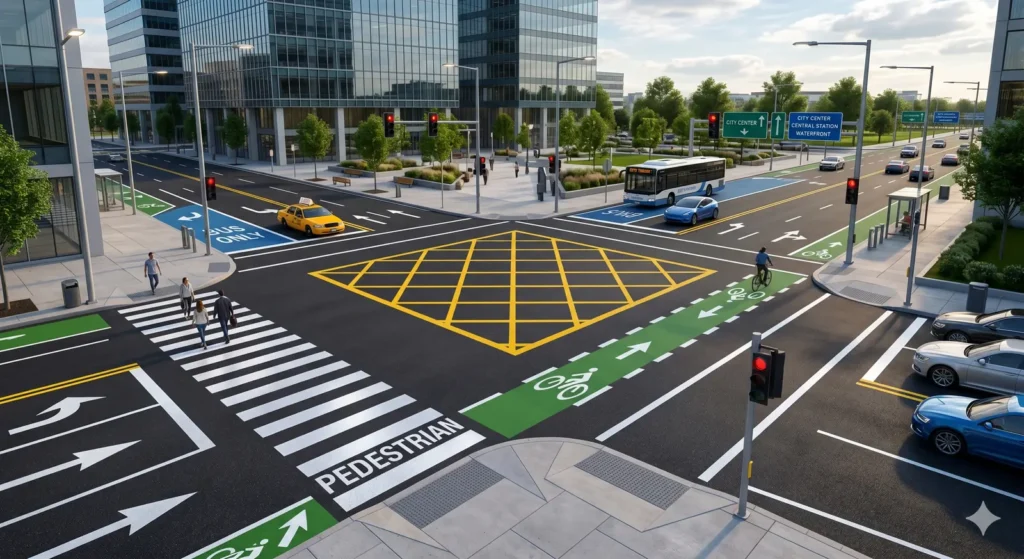
2. Yellow box junctions and keep-clear markings
A box junction is a large area of hatching crossed by every vehicle through the junction. In thermoplastic it becomes a patchwork of worn and re-marked sections; in MMA it stays a box. The same applies to keep-clear markings at emergency exits and hospital entrances.
3. Coloured bus and cycle lanes
Colour is where MMA has no real competitor. Coloured thermoplastic fades and dirties; coloured paint fades fast. Coloured MMA with an anti-skid aggregate stays recognisably red or green for years, which is the whole point of a coloured lane. Many designs colour only the conflict points — junctions, side-road crossings and bus stops — rather than the full lane length, which keeps the cost proportionate. See cycle track markings.
4. Concrete surfaces and bridge decks
Hot thermoplastic bonds poorly to concrete and needs a primer; MMA bonds directly and copes with the thermal movement of a bridge deck. On concrete car park ramps, flyovers, tunnels and airport aprons, MMA is often the only marking material that lasts.
5. Ramps, bends and crossing approaches — anti-skid
Where the specification calls for high-friction surfacing, MMA anti-skid is the system. Coloured approaches to pedestrian crossings and school zones, helical ramps in multi-storey car parks and bends with a history of skidding are the typical locations.
6. Very short closure windows
MMA cures in 20–40 minutes and can be applied at night in cooler temperatures. Where a lane can be closed for only an hour, MMA sometimes wins on programme even where a cheaper material would technically do — the closure costs more than the material.
Where MMA is not worth it
- Kilometres of highway lane line. Thermoplastic gives years of service at a fraction of the cost. MMA’s advantage is at stress points, not along the open road. See thermoplastic road marking.
- Car park bays in paint-friendly conditions. Ordinary bays on a lightly used deck are fine in acrylic or epoxy line paint; MMA is reserved for EV, accessible or heavy-duty bays.
- Temporary layouts. MMA is hard to remove; do not put it where the layout will change next year.
- Surfaces that cannot be prepared. MMA bonds to almost anything but it also bonds faithfully to dust. If the surface cannot be cleaned and dried, no material will save it.
Specifying MMA correctly
- State the application: screed (2–3 mm), spray (0.6–1 mm) or anti-skid with aggregate (3–4 mm), and the colour.
- Name the standard (BS EN 1871 cold plastic types are commonly referenced) and the required skid resistance for anti-skid areas.
- Require drop-on glass beads for reflectivity on lines; profiled or structured MMA where wet-night visibility matters.
- Specify surface preparation: clean, dry, sound; primer on dense concrete where the manufacturer requires it; new asphalt aged as advised.
- Ask for application records with mix ratio, hardener percentage, temperature and thickness, and for skid-resistance test results where specified.
Cost in context
Per square metre MMA is several times the cost of thermoplastic and many times the cost of paint, so a design that colours every metre of a cycle lane will cost a great deal. But per year of service at a junction it is usually the cheapest material on the road, and once the cost of closures to redo failed markings is counted, the case is rarely close. Our road marking cost guide explains how the alternatives are priced; send us the drawings and we will quote MMA against thermoplastic for each location so the decision can be made line by line.
A worked example: a signalised junction remodel in Doha
Four arms, a new left-turn lane, box junction, stop lines, crossings and coloured cycle approaches on two arms, all inside night closures. The specification put MMA at the junction — box junction and keep-clear hatching, stop and give-way lines, the first 30 m of each lane line on the approaches, and green anti-skid cycle approaches — with thermoplastic for the lane and edge lines beyond. The old markings were water-blasted off on the first night; on the following nights the MMA was screeded arm by arm with the closure moving around the junction, each arm curing in about 30 minutes before the closure was lifted; the thermoplastic followed on the final two nights. The MMA area was under 300 m² in a scheme with several kilometres of thermoplastic, so the premium material was a small share of the total — and it is the part of the junction that will still be intact when the lane lines beyond it are refreshed.
Application notes for site teams
- Mix ratio and hardener percentage are set for the day’s temperature — more in cool night air, less in summer — and recorded per batch.
- Pot life is short; mix what can be laid in the next few minutes.
- Beads or aggregate go on immediately, while the surface is wet.
- Do not open to traffic until the surface is hard to a thumbnail test; typically 20–40 minutes.
Frequently asked questions
What is the difference between MMA and thermoplastic?
Thermoplastic is melted and laid hot, sets on cooling and is the economical long-life choice for lane lines. MMA is a two-component resin applied cold that cures chemically, bonds to concrete, holds colour and takes anti-skid aggregate — the premium choice for junctions, coloured lanes and high-friction areas.
Is anti-skid surfacing the same as MMA?
Anti-skid (high-friction) surfacing is MMA resin with a hard, high-PSV aggregate such as calcined bauxite broadcast into it. MMA can also be applied without aggregate as a plain or coloured marking.
Where is MMA worth the extra cost?
Signalised junctions and stop lines, box junctions, coloured bus and cycle lanes, concrete surfaces and bridge decks, ramps and crossing approaches needing anti-skid, and very short closure windows.
Where should I use thermoplastic instead?
Along the open road — highway lane and edge lines over long distances — and for standard car park bays and temporary layouts, where MMA’s durability is not needed and its cost and permanence count against it.
How long does MMA last in Qatar?
Longer than any other marking material at the same location; coloured MMA surfacing typically stays recognisable for years and is usually replaced because the layout changes, not because it has worn out.
Get a free site visit and a same-day quotation
Send us the location, the approximate area or number of bays and any drawings you have. A UniGulf engineer will survey the site, confirm the material specification and send an itemised quotation — usually the same working day.