
Road studs — cat’s eyes — are the cheapest safety device on a road per metre and the most abused. Specified well and installed properly they keep a lane readable at night, in rain and in blowing dust when the painted line has vanished under headlights; specified badly they litter the hard shoulder within a season. This guide explains the two families of stud used in Qatar, how spacing and colour work, and the installation details that decide whether a stud lasts weeks or years. For the service, see road studs supply and installation.
How a road stud works
A stud does two things: it reflects headlight back to the driver through a retro-reflective element, and it gives a tactile and audible warning when a tyre crosses it. The reflector is a prismatic lens or a reflective glaze; the body protects it from tyres and holds it to the road. Because the reflector sits above the road surface it is not dulled by the film of dust that kills a painted line’s reflectivity, and because it is a point source it reads clearly from a distance.
Aluminium studs
Cast aluminium studs are the highway standard. A body of roughly 100–130 mm across is bedded onto the road, with a prismatic reflector fitted in a recess angled so that tyres pass over the body rather than the lens. The reflector is replaceable: when it wears or is damaged, the insert is changed and the body stays. Aluminium studs are rated for heavy truck traffic and are used on expressways, arterial roads, interchanges and industrial estate roads. Bi-directional versions carry a reflector on each face for two-way roads; uni-directional studs face oncoming traffic on dual carriageways.
Ceramic studs
Ceramic studs are glazed dome markers around 100 mm in diameter, low profile, very visible in daylight because of their bright glaze, and reflective at night through the glaze or an added reflector. They are economical and easy to install, and they suit lower-speed roads: roundabouts, compound and internal roads, car park ramps and aisles, access roads and industrial yards. They are less tolerant of heavy truck traffic than a cast aluminium body, which is why they are not the highway choice.
Solar LED studs
Active studs with a solar cell and LEDs are used where a self-illuminating marker is specified — pedestrian crossings, hazardous bends, tunnel approaches, cycle tracks and airport landside roads. They are more expensive per unit and need occasional replacement of the unit rather than a reflector insert, but they are visible far beyond the range of a passive reflector.
Colour coding
Colour tells the driver what the stud marks. The conventions used on Qatar roads, following the Qatar Traffic Control Manual and the project specification, are:
| Colour | Position | Meaning |
|---|---|---|
| White | Lane lines | Separation between lanes in the same direction |
| Yellow | Edge / median | The edge of the carriageway next to the central reserve or median |
| Red | Nearside edge / hazard | The outer edge of the carriageway; do not cross |
| Green | Lay-bys, slip roads, access | Edge of the carriageway where a road or lay-by joins |
| Blue | Emergency bays (where specified) | Marks emergency or police stopping points |
Colour conventions vary between countries, so always take them from the Qatar standard or the project drawings rather than a supplier’s catalogue.
Spacing
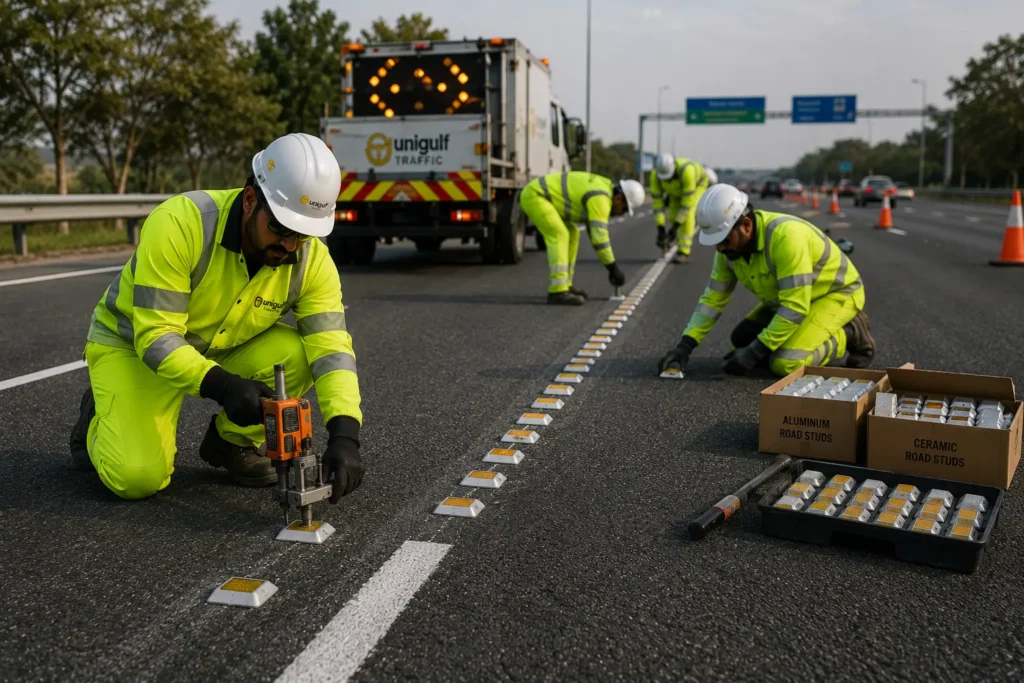
Spacing comes from the specification and the QTCM conventions. The principle is that a driver must always see the next stud: wider spacing on straight highway lane lines, closer spacing on curves, ramps, merges and hazard lengths, and closer still at hazards such as narrowings and pedestrian crossings. Edge studs are commonly spaced differently from lane studs, and studs on a broken lane line are usually placed in the gaps between the painted dashes so tyres crossing the line meet the stud. We set out from the lane line with a consistent offset so the studs read as a straight, even row — uneven studs look unfinished and are, in our experience, the first thing a consultant photographs.
Installation: where studs are won or lost
Almost every stud failure we see is an installation failure. The position must be clean, dry and sound: sweep and blow the spot, remove loose aggregate and dust, and on old asphalt abrade or prime it. The adhesive must be the one the stud manufacturer and the specification call for — a two-part epoxy for most aluminium and ceramic studs, or hot bitumen adhesive where specified — mixed correctly and applied so the whole base of the stud is bedded with a small fillet squeezed out around it. The stud must be oriented so the reflector faces oncoming traffic, and it must not be trafficked until the adhesive has cured. On new asphalt, wait for the surface to cure. Skip any of those and the stud is a projectile.
Specifying studs on a project
- Type: cast aluminium with replaceable prismatic reflector for public roads; ceramic for low-speed private roads and car parks; solar LED where an active marker is required.
- Reflector: uni- or bi-directional, colour per position, performance to the standard named in the specification (BS EN 1463 type classes are commonly cited).
- Spacing: per QTCM and the drawings, reduced on curves and hazards.
- Adhesive: two-part epoxy or bitumen adhesive per manufacturer; surface preparation stated in the method statement.
- Records: quantities, positions and adhesive batch on the application record.
Studs are installed with the thermoplastic lane lines on new roads and as a stand-alone package on existing ones, and we replace damaged studs and reflectors on maintenance contracts. Send the drawings and we will quote per unit, supplied and installed.
A worked example: a 3 km industrial estate road
Dual carriageway, two lanes each direction, trucks around the clock. The specification called for cast aluminium studs with prismatic reflectors: white on the lane line in the gaps between the broken thermoplastic dashes, yellow on the median edge, red on the nearside edge, with closer spacing on the two roundabout approaches and the ramps to the weighbridge. The studs were installed the night after the thermoplastic lines, inside the same lane closure, with each position swept and blown, the epoxy adhesive mixed in small batches to suit the temperature, and the studs pressed home with a fillet squeezed out around the base. Traffic was held off the closure until the adhesive had cured. Twelve months later the maintenance inspection found four reflectors damaged by a plant movement and no studs missing — the reflectors were replaced in an hour without touching the bodies. That outcome is normal when the installation is done properly and unusual when it is not.
Maintenance
Studs are inspected with the lines: missing or damaged studs and dull or broken reflectors are noted at the annual night inspection and replaced in a single visit. Reflector inserts on aluminium studs are a stock item; ceramic studs are replaced whole. Keeping a small stock of the project’s stud type on site makes replacement a maintenance task rather than a procurement exercise.
Frequently asked questions
Should I specify aluminium or ceramic road studs?
Aluminium with replaceable prismatic reflectors for public roads, highways and anywhere trucks run; ceramic glazed studs for roundabouts, compound roads, car park ramps and other low-speed private roads.
What do road stud colours mean in Qatar?
White marks lane lines, yellow the median edge, red the nearside edge or a hazard, green lay-bys and access points and blue emergency bays where specified — always confirmed against the project drawings.
How far apart are road studs installed?
To the specification and QTCM conventions: wider on straight lane lines, closer on curves, ramps and hazards, so the driver always sees the next stud.
Why do road studs come loose?
Almost always installation: a dusty or damp position, the wrong adhesive, poor bedding, or traffic before the adhesive cured. Correct preparation and epoxy bedding keep studs fixed for years.
Can reflectors be replaced without replacing the stud?
Yes, on aluminium studs: the prismatic insert is replaced and the body stays bedded to the road, which is why they are the maintenance-friendly choice on highways.
Get a free site visit and a same-day quotation
Send us the location, the approximate area or number of bays and any drawings you have. A UniGulf engineer will survey the site, confirm the material specification and send an itemised quotation — usually the same working day.