
Electric vehicle chargers are going into Qatar car parks faster than the car parks were designed for them. The charger arrives, the electrical contractor mounts it on a wall or a bollard, and somebody is asked to “mark the EV bay”. Done properly, EV charging bay marking makes the bay findable, enforceable and safe to use with a cable; done badly, it is a green rectangle that petrol cars park in. This guide covers layout, colour, symbols, signage and the materials that keep coloured bays looking new, based on the layouts we install for charging operators and developers. For the service, see car park, warehouse and EV bay marking.
Start with the charger, not the bay
The bay layout follows the charger: where the unit is, which side the cable exits, how far it reaches, whether one unit serves one bay or two, and whether the vehicle parks nose-in or reverses in. A wall-mounted 7–22 kW AC charger typically serves one or two bays with the cable reaching the charge port on either side; a DC fast charger on a plinth often serves two bays and needs a protected zone in front of it. Most charging operators have a layout standard for their units, and the marking should be set out to it. Confirm the charger positions on site before marking — drawings and reality differ, and a bay marked to the wrong side of a bollard is useless.
Bay dimensions
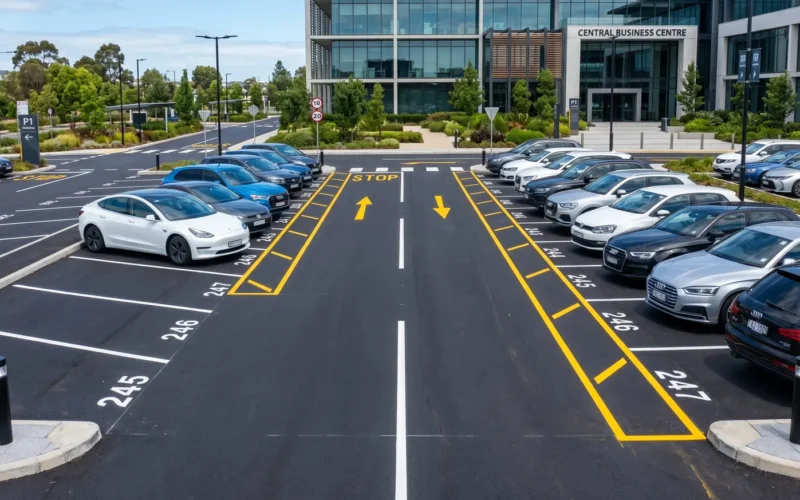
An EV bay is a standard bay with two extra allowances: room to open the charge port door and handle a cable, and a clear zone at the charger so it is not hit by a bumper. In practice we use the standard bay width for the project — commonly 2.5 m in Qatar — increased to 2.7–3.0 m where the operator requires it, with a hatched clear zone of around 0.5–1.0 m at the charger end or side. Accessible EV bays follow the accessible bay standard (around 3.6 m including the transfer zone) and should be provided where the car park has accessible bays generally. See bay sizes and layout standards for the general rules.
Colour and symbols
There is no single mandated colour in Qatar for EV bays, but the convention that has emerged — and that operators and developers ask for — is green. Two treatments are common:
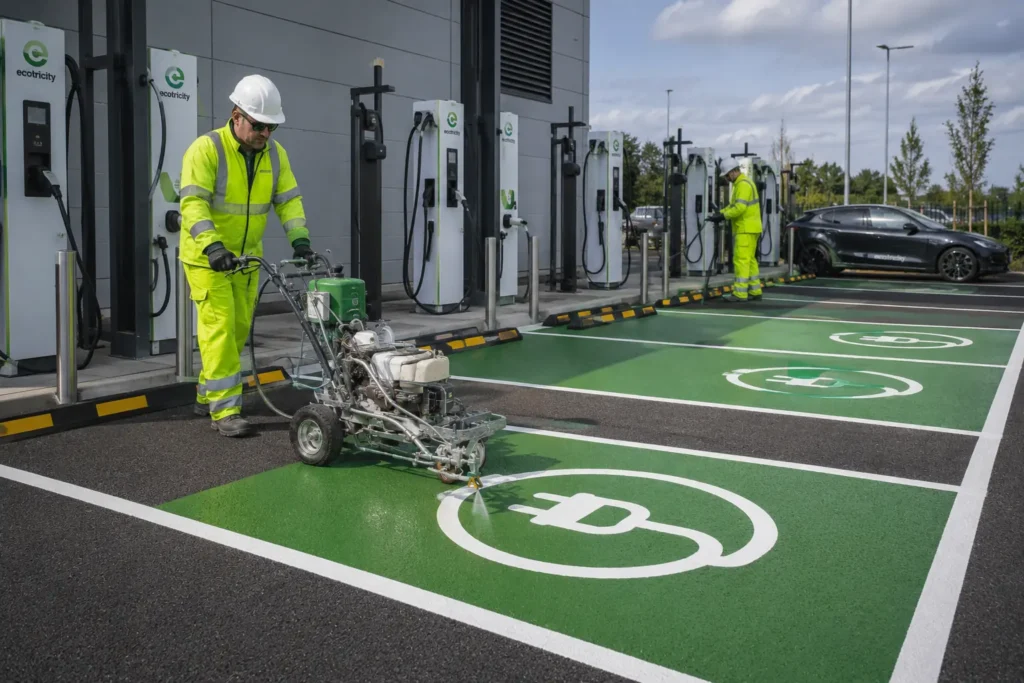
- Full green surface across the bay with a white EV symbol and white bay lines. Most visible, most enforceable, most material.
- Green border or green symbol only on a standard bay. Economical, still clearly identifies the bay, easier to change later.
The symbol is usually a white vehicle-with-plug pictogram or the letters “EV”, sized to the bay and centred, with an arrow if the bay is reversed-in. Add “EV CHARGING ONLY” or the operator’s wording as a stencilled legend where enforcement is a concern. Keep the colour consistent across the car park; a mix of green shades on different levels looks unplanned.
Charger protection and hatching
Hatch the zone in front of or beside the charger in the same green or in yellow so drivers stop short of the unit, and fit wheel stops set so a nose-in vehicle cannot reach the charger. Bollards are usually installed by the electrical contractor; the marking should show the clear zone around them. On plinth-mounted DC chargers, a hatched island with a kerb or bollards is the norm.
Signage
Marking on the floor is not enough on its own, because a parked car hides it. Each EV bay or bank of bays should have a wall or post sign identifying it as a charging bay, with the operator’s branding and any time limit or tariff information, and directional signs from the car park entrance to the EV bays. Height and position should follow the car park signage scheme. We supply and fit these with the marking — see traffic signage boards.
Materials: keeping green bays green
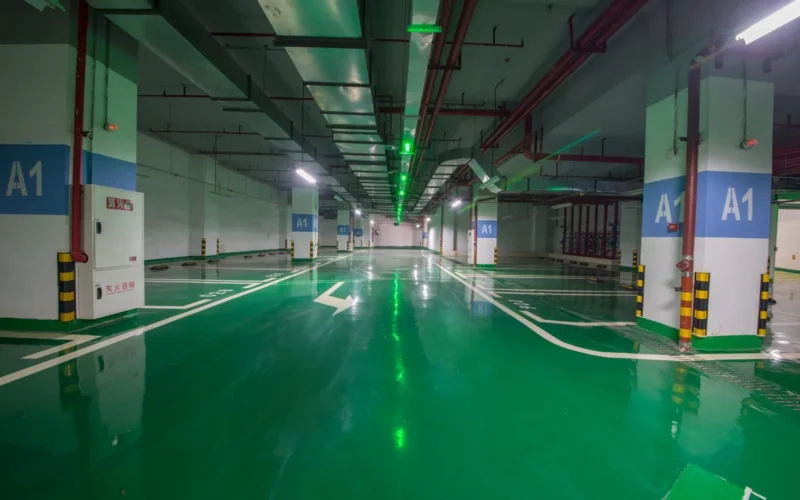
Coloured bays are where material choice shows. On outdoor asphalt, coloured MMA cold plastic with an anti-skid aggregate gives the longest-lasting green and the best grip; coloured thermoplastic is an alternative for symbols. On concrete decks and basements, coloured epoxy or polyurethane floor coating bonds to the slab, resists tyre marks and cleaning chemicals, and is applied with the bay lines and symbol in white line paint on top. Acrylic paint is the budget option on either surface; it is quick and cheap but a full green paint bay will show tyre marks and wear within a year in a busy car park. Where a whole basement is being coated, EV bays are simply a different colour within the epoxy flooring scheme.
Anti-slip matters on green bays: a smooth coloured surface with a dropped cable and a wet floor is a claim waiting to happen. We add aggregate to coloured surfacing on ramps and outdoor bays and specify a textured finish indoors.
Retrofitting EV bays into an existing car park
Most EV bay work in Qatar is retrofit. The sequence that works: confirm charger positions with the electrical contractor; choose the bays nearest the supply and, ideally, near entrances and lifts; remove the old bay markings by grinding rather than painting over (a blacked-out line under a green bay is visible for years); prepare the floor; apply the colour; mark the lines and symbol; fit wheel stops and signs. In a live car park this is done in an overnight section with the bays coned off until the material has cured.
A short specification you can copy
- Bay: standard bay width increased to 2.7 m; length per car park standard; hatched clear zone 0.6 m at charger side.
- Surface: full green coloured surfacing — MMA with anti-skid aggregate (asphalt) or coloured epoxy/PU (concrete).
- Lines: 100 mm white; symbol: white EV pictogram centred; legend: “EV CHARGING ONLY”.
- Protection: wheel stop per bay; bollards to charger installer’s detail; hatching at charger.
- Signage: bay sign per bay or bank; directional signs from entrance.
- Records: layout confirmed with operator; material data sheets and application record at handover.
Send us the charger layout and the car park drawing and we will mark up the bays, quote per bay and install with the charger programme.
Common mistakes we are asked to correct
- Bay marked to the wrong side of the charger. The cable will not reach the port on the vehicles that actually use the bay. Confirm the unit position and cable exit on site.
- Green paint on a busy deck. Tyre marks within weeks, worn through within a year. Use coloured MMA or epoxy for full-surface bays.
- No hatching at the charger. The unit is hit by a bumper within a month. Hatch the clear zone and fit wheel stops.
- Floor marking only, no sign. Petrol cars park in the bay because the marking is under a car. Fit a sign per bay or bank.
- Old bay lines painted over. The previous layout shows through the green. Grind first.
- Inconsistent green. Three shades across three phases looks unplanned. Specify the colour once and keep the data sheet.
Frequently asked questions
What colour should EV charging bays be in Qatar?
Green is the convention operators and developers use — either a full green bay surface with a white EV symbol, or a green border or symbol on a standard bay. Confirm the operator’s standard and keep the shade consistent across the car park.
How big should an EV charging bay be?
A standard bay, commonly 2.5 m wide in Qatar, widened to around 2.7–3.0 m where the operator requires cable room, with a hatched clear zone of about 0.5–1.0 m at the charger. Accessible EV bays follow the accessible bay standard.
Which material keeps green EV bays looking new?
Coloured MMA with anti-skid aggregate on asphalt; coloured epoxy or polyurethane coating on concrete. Acrylic paint is cheaper but shows tyre marks and wear within a year in busy car parks.
Do EV bays need signs as well as floor marking?
Yes. A parked car hides the floor marking, so each bay or bank needs a wall or post sign, plus directional signs from the entrance.
Can EV bays be added to an existing car park?
Yes. The old bay markings are removed by grinding, the floor prepared, the colour applied and the bays marked and signed, usually in an overnight section so the car park stays open.
Get a free site visit and a same-day quotation
Send us the location, the approximate area or number of bays and any drawings you have. A UniGulf engineer will survey the site, confirm the material specification and send an itemised quotation — usually the same working day.