
A warehouse floor with no markings is a warehouse where forklifts and people share the same space by luck. Floor marking separates them, tells drivers where to go and where to stop, shows where stock may and may not be placed, and keeps fire equipment and exits clear. This guide sets out the colour conventions used for warehouse floor marking in Qatar, the line widths and layouts that work, and the materials that survive solid forklift tyres. For the service, see warehouse and car park line marking.
Why colour codes matter
There is no single legally mandated colour code for warehouse floors in Qatar; what matters is that the code is consistent, documented in the site’s safety rules and taught at induction. The conventions below are widely used across logistics, manufacturing and cold storage operators and are the ones we install unless a client’s corporate standard says otherwise.
| Colour | Meaning | Typical use |
|---|---|---|
| Yellow | Traffic and caution | Forklift lanes and aisles, traffic flow arrows, working area boundaries |
| Green | Safe / pedestrian | Pedestrian walkways, first-aid points, safety equipment locations |
| Red | Fire and emergency | Fire equipment keep-clear zones, hose reels, extinguishers, fire doors |
| Red / white hatching | Keep clear for emergency access | In front of fire equipment, exits, electrical panels |
| Black / yellow hatching | Physical hazard | Column bases, dock edges, racking ends, low headroom |
| Blue | Storage / materials | Storage locations, raw material and finished goods zones |
| White | General organisation | Racking footprints, pallet positions, bin locations |
| Orange | Inspection / hold | Quarantine, awaiting inspection, returns |
| Black / white hatching | Operational keep-clear | Areas to keep free for operations (not safety) |
Forklift lanes
Forklift lanes are marked in solid yellow lines, typically 75–100 mm wide, with the lane wide enough for the largest truck plus load and a margin — commonly 3.0–3.5 m for a one-way lane and 6.0 m or more for two-way, adjusted to the trucks and loads in use. Mark flow arrows at intersections and at aisle entries, STOP or give-way lines where lanes cross pedestrian routes, and mirror positions where visibility is poor. Speed limits are signed, not painted, but a painted SLOW at blind corners helps.
Pedestrian walkways
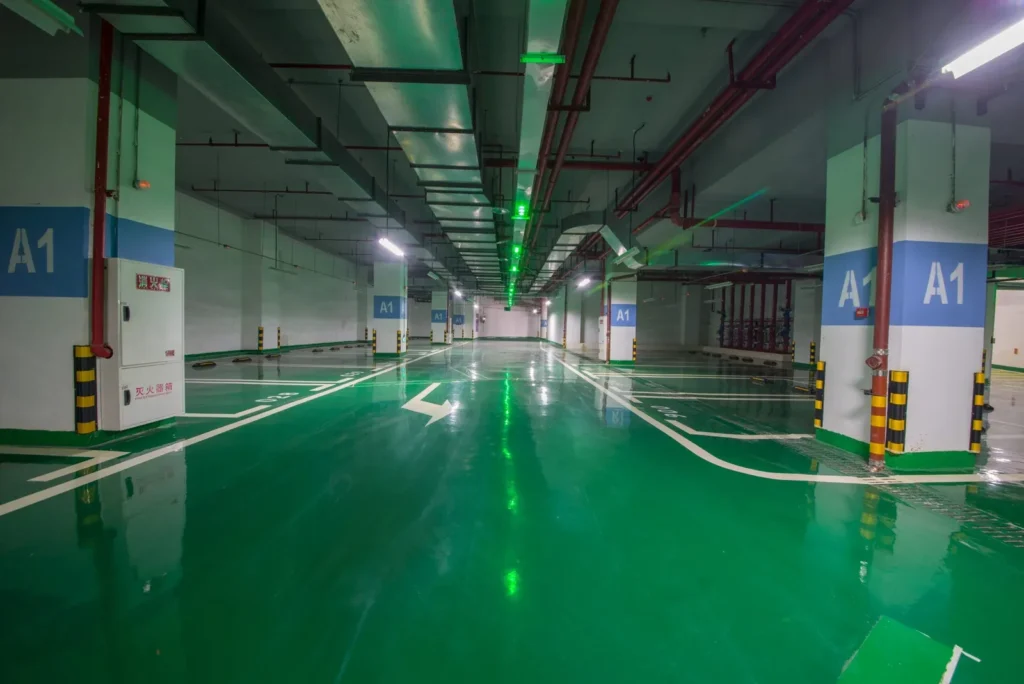
Walkways are the most important markings on the floor. Mark them in solid green, 1.0–1.2 m wide, with a green edge line or a full green surface, and take them the way people actually walk — from the entrance to the offices, welfare areas and workstations — rather than around the perimeter where nobody uses them. Where a walkway crosses a forklift lane, mark a zebra crossing with give-way lines for the trucks and, if traffic is heavy, a barrier gate for pedestrians. Fixed barriers at the crossing edges protect the walkway where the risk is highest.
Hatching and keep-clear zones
Red-and-white hatching in front of fire extinguishers, hose reels, fire doors and electrical panels keeps them reachable; black-and-yellow at column bases, racking ends and dock edges warns of things a truck can hit. Hatching should be large enough to be seen from a truck seat — a 1 m square in front of an extinguisher, the full width of a fire exit — and the rule that nothing is placed on a hatched area needs to be enforced, or the marking loses its meaning.
Storage zones and pallet positions
Blue zone lines and white pallet positions turn a floor into a plan: every pallet has a place and every place has a code. Mark bulk storage blocks with a boundary line and a location code stencilled at the front; mark racking footprints so the racking installer sets out to the marking and the lanes remain true. Orange for quarantine and returns keeps rejected stock out of the flow.
Line widths and details
- Lanes and zones: 75–100 mm solid lines; 100 mm for walkways.
- Hatching: 100 mm stripes at 45°.
- Symbols: arrows 1.0–1.5 m long; STOP legends 300–500 mm letters.
- Location codes: 150–300 mm stencilled characters, readable from the aisle.
Materials that survive forklifts
Ordinary road paint on a warehouse floor lasts weeks in the lanes. Solid tyres on a loaded forklift, pallet trucks dragging and floor scrubbers grinding are far harder on a line than a car. The materials that last are:
- Two-part epoxy line paint on a prepared concrete floor — the standard choice, bonding to the slab and resisting abrasion and cleaning chemicals.
- MMA cold plastic for the highest-wear lanes and coloured zones, fast-curing and very hard-wearing.
- Coloured epoxy floor coating where the whole floor is being sealed — walkways and zones become part of the epoxy flooring scheme rather than lines on top of it.
Preparation decides the result: grinding to remove laitance, curing compound and contamination, and a primer where the coating system requires it. Lines painted on a dusty, unprepared slab peel at the first scrub.
Sequencing with racking and operations
The efficient sequence is: finalise the racking and lane layout on drawing; prepare and, if required, coat the floor; mark the racking footprints and lanes before the racks arrive; install racking to the marks; then mark walkways, crossings and zones. In a live warehouse, marking is done zone by zone at night or weekends with stock moved back after cure. Old layouts are removed by grinding — see line marking removal — so ghost lines do not confuse drivers.
Keep the code alive
Print the colour code on a board at the warehouse entrance, include it in the induction, and audit the floor quarterly: lines worn through, hatching covered with pallets, walkways blocked. A floor marking scheme is a management tool, and it works only while it is maintained.
A worked example: a 12,000 m² logistics warehouse in the Industrial Area
New build, power-floated slab, racking arriving in two weeks, operations starting in four. We marked the racking footprints and the main forklift lanes from the racking drawing before the racks arrived, so the installer set out to our lines and the aisles came out true. Once the racking was in, the pedestrian walkways were marked from the staff entrance to the offices and welfare block with zebra crossings and give-way lines at each lane crossing, fire equipment and exits were hatched red and white, column bases and dock edges black and yellow, bulk storage blocks in blue with stencilled location codes, and a quarantine zone in orange beside goods-in. Everything was applied in two-part epoxy line paint on a ground and primed slab, with the colour code printed on a board at the entrance for induction. Total floor marking time: five nights, with the crew working ahead of the racking installer and then behind them. A year later the lanes and walkways were still intact under solid-tyre traffic; the only refresh needed was the loading dock hatching, which takes the most abuse on any warehouse floor.
Specification summary
- Lanes: 100 mm yellow epoxy line paint; arrows at intersections; SLOW at blind corners.
- Walkways: 1.2 m green, edge lines 100 mm; zebra crossings with give-way lines at lane crossings.
- Hatching: 100 mm stripes at 45°, red/white at fire equipment and exits, black/yellow at hazards.
- Zones: blue boundaries with stencilled codes; orange quarantine; white pallet positions.
- Preparation: grind, vacuum, prime; adhesion test on any coated area.
Frequently asked questions
What colour are forklift lanes marked?
Yellow, in solid 75–100 mm lines with flow arrows at intersections, following the widely used warehouse convention. Pedestrian walkways are green so the two are never confused.
What does red-and-white hatching mean on a warehouse floor?
Keep clear for emergency access — in front of fire extinguishers, hose reels, fire doors and electrical panels. Nothing should be placed on it.
How wide should a pedestrian walkway be?
Typically 1.0–1.2 m, marked in green, routed the way people actually walk, with zebra crossings and give-way lines where it crosses forklift lanes.
What paint lasts on a warehouse floor?
Two-part epoxy line paint on a prepared concrete floor, MMA cold plastic for the hardest-worn lanes, or coloured epoxy floor coating where the whole floor is sealed. Road paint wears off in weeks under solid forklift tyres.
Can you mark a warehouse while it is operating?
Yes, zone by zone at night or weekends, with stock moved back once the material has cured and old layouts removed by grinding.
Get a free site visit and a same-day quotation
Send us the location, the approximate area or number of bays and any drawings you have. A UniGulf engineer will survey the site, confirm the material specification and send an itemised quotation — usually the same working day.