
A school yard in Qatar is a hard place for a marking: 45 °C asphalt, relentless UV, sand, and several hundred children a day. It is also one of the most rewarding places to mark, because a well-planned set of playground markings changes how the yard is used — children move more, teachers have a structure for outdoor lessons, and a bare rectangle of asphalt becomes a place. This guide covers how to plan playground markings for schools and nurseries in Qatar: designs by age group, the materials that survive, the surfaces that work and how to schedule the installation. For the service, see playground markings in Qatar.
Start with how the yard is used
Before choosing designs, map the yard: where children line up, where they run, where the shade is, where the ball games happen, where the youngest children play and where the drop-off traffic comes in. Markings should reinforce the good patterns — line-up spots at the doors, a running track around the edge, quiet games in the shade, ball courts away from the nursery zone — rather than fight them. A drawing with the designs placed to scale is the single most useful step, and we provide one before installation.
Designs by age group
Nursery and kindergarten (3–5)
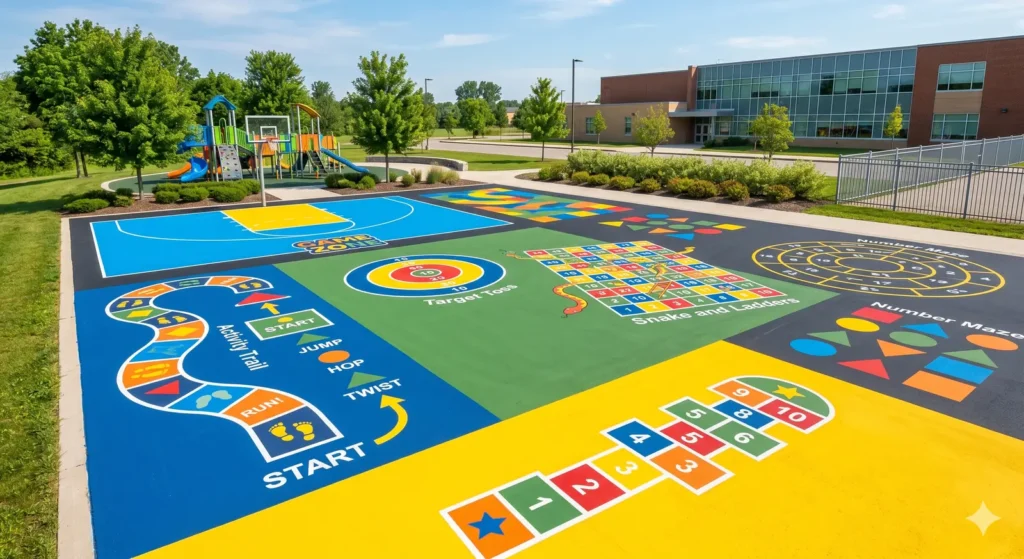
Simple, large and colourful: shapes and colour circles for recognition games, footprints and stepping stones for balance, a short number line, a caterpillar or snake with letters, and a small mini road with a zebra crossing for tricycles. Keep designs spaced so groups do not collide, and keep them near the building and the shade.
Primary (6–11)
Games and learning: hopscotch (several, because it is always the busiest), number grids to 100, multiplication squares, an alphabet grid, a clock face, a compass, a world map, target games, four-square and a mini road layout with junctions, roundabout and crossings for road-safety lessons. Add a running track with lanes and a long-jump run-up, and court lines for football, basketball and netball on the sports area.
Secondary (12+)
Sports and social space: full or reduced court markings for basketball, volleyball, football and netball, often overlaid as a multi-use games area in different colours; a running track; fitness circuits with station markings; and line-up and assembly markings. Educational grids are less used at this age, so spend the budget on courts.
Road-safety and mini road layouts
A mini road layout — lanes, a roundabout, junctions, a zebra crossing, stop lines and cycle symbols — is popular with schools running road-safety programmes and gives tricycles and scooters a purpose. We mark them in the same thermoplastic and colours used on real roads, at a child’s scale, and can add small traffic signs for realism.
Materials that survive the sun
Most playground designs are preformed thermoplastic: pre-cut, pigmented sheets with an anti-slip aggregate, laid on the asphalt and heat-fused into the surface at around 3 mm thickness. Because the design is factory-made, the lines are exact and the colours are consistent; because it is thermoplastic, it will not peel like paint and it keeps its colour under UV for years. Large coloured areas — safety zones, court surfaces, mini road backgrounds — are applied in coloured MMA or acrylic surfacing with a fine anti-slip aggregate; MMA where the area is large and the life must be long, acrylic where the budget leads. All materials are lead-free and finished with a textured, non-slip surface.
Surfaces
Asphalt is the ideal surface: thermoplastic bonds into it and it is what most Qatar school yards are made of. Sound concrete can be marked with a primer. Interlock paving is possible for surfacing but joints make preformed designs less crisp. Rubber wet-pour safety surfacing and artificial turf need different systems entirely and are assessed case by case. Cracked, crumbling or heavily patched asphalt should be repaired first; a marking is only as good as the surface under it.
Layout tips that avoid problems
- Keep 1.5–2 m between designs so games do not overlap.
- Put hopscotch and skipping games away from doors and thoroughfares.
- Orient number and letter grids so children read them from the building side.
- Keep ball courts away from windows and the nursery zone; add a rebound wall target instead of a full court if space is short.
- Mark line-up spots and waiting zones at every door used at drop-off and pick-up.
- Use colour zoning — a colour per year group or activity — to organise a large yard.
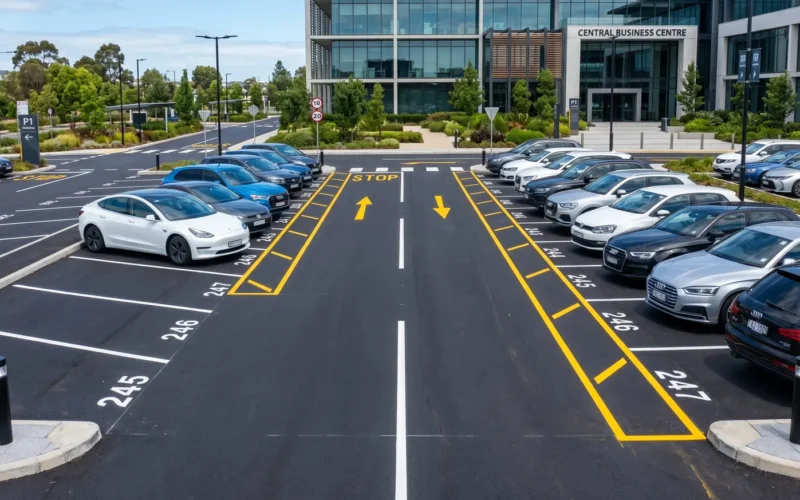
- Mark the car park and drop-off lane in the same visit: bays, arrows, a pedestrian route and a no-stopping zone at the gate. See car park marking.
Scheduling around the school year
Holidays are ideal: the yard is empty, the whole layout can be finished in one continuous run and the material is fully set before children return. Term-time installation is possible after hours or over weekends, zone by zone. A typical primary yard with a dozen designs and a mini road takes one to three days; add the sports courts and it is a week. Summer heat is not a problem for the materials — thermoplastic goes down hot anyway — but early-morning and evening working keeps the crew comfortable.
Maintenance
Preformed thermoplastic designs need almost none: sweep the yard, and expect years of service before a refresh. Coloured surfacing is refreshed on a longer cycle depending on use. If a design is damaged — a repair, a new drain — the section can be cut out and replaced rather than the whole design redone. See how long markings last in Qatar for the general picture.
Send us a photo or a plan of the yard and the age groups using it and we will propose a layout, with a drawing and a price per design.
A worked example: a primary school yard in Al Rayyan
A 1,800 m² asphalt yard shared by nursery and primary classes, marked during the summer holiday. The layout drawing placed the nursery zone in the shaded corner nearest the building — colour circles, footprints, a caterpillar alphabet and a small tricycle road — and the primary games in the open yard: three hopscotch grids, a 1–100 number grid, a multiplication square, a clock, a compass, a target game and a four-square court, with a 60 m running track in lanes around the perimeter and a basketball half-court against the boundary wall. Line-up spots were marked at both doors and a pedestrian route was marked from the gate to the entrance across the drop-off lane, which was marked with a no-stopping zone and arrows in the same visit. Installation took three days: one day of surface repair and cleaning, two days of preformed thermoplastic and the coloured tricycle road in MMA. The school opened in September with a yard that organised itself.
Budgeting
Designs are priced individually and coloured areas per square metre, so a yard can be phased: games and line-up spots first, sports courts and coloured zones later. Preformed designs are quick to add to an existing yard in a single after-hours visit.
Frequently asked questions
What playground markings suit a nursery?
Simple, large, colourful designs: shapes and colour circles, footprints and stepping stones, a short number line, a letter snake and a small mini road with a zebra crossing, placed near the building and the shade.
What are playground markings made of?
Mainly preformed thermoplastic — pre-cut, pigmented, anti-slip designs heat-fused into asphalt at about 3 mm — plus coloured MMA or acrylic surfacing for larger areas. All are lead-free and non-slip.
Will the markings fade in the Qatar sun?
Outdoor-grade thermoplastic and MMA pigments are UV-stable and keep their colour for years; paint fades fastest, which is why we do not recommend it for play designs.
Can markings go on rubber safety surfacing?
Not with the standard systems. Rubber wet-pour and artificial turf need special products and are assessed case by case; asphalt is the ideal surface.
How long does installation take?
One to three days for a typical primary yard with a dozen designs and a mini road; about a week with sports courts. Holidays are ideal, but after-hours term-time work is possible.
Get a free site visit and a same-day quotation
Send us the location, the approximate area or number of bays and any drawings you have. A UniGulf engineer will survey the site, confirm the material specification and send an itemised quotation — usually the same working day.