
“How long will it last?” is the question behind every material decision, and the honest answer in Qatar is: it depends on what wears it out. Road markings do not fade on a calendar; they are worn away by tyres, baked by the sun, scoured by sand and undermined by whatever was under them when they were applied. This article explains the mechanisms, gives realistic service-life ranges for each material, and lists the things that make the difference between a line that lasts two summers and one that lasts six. For the materials themselves, see thermoplastic, acrylic paint and MMA cold plastic.
What wears a road marking out
Tyre abrasion
The dominant factor everywhere, and doubly so in Qatar because of the sand. Tyres crossing a line grind sand into it like a lapping compound. Lane lines that are constantly crossed — at lane changes, merges, roundabouts and junctions — wear many times faster than edge lines that tyres rarely touch. That is why a highway edge line can look new while the lane line next to it is half gone.
Surface temperature and UV
Asphalt in a Qatar summer can reach surface temperatures well above 60 °C. Thermoplastic softens slightly and can pick up tyre marks and dirt; paint films become brittle over repeated cycles; pigments and resins degrade under UV, which is why cheap paints yellow and coloured surfaces fade. Materials formulated for hot climates — with UV-stable pigments and resins with higher softening points — hold up far better, which is one reason we do not use whatever is cheapest that month.
Sand and dust
Beyond abrasion, a layer of fine dust on a line kills its retro-reflectivity at night long before the material has physically worn away. A line can be structurally sound and functionally invisible. Sweeping and rain restore it; in dusty industrial areas the interval between cleans is part of the maintenance plan.
What was underneath
Failure from below is the fastest failure of all. A line applied to a dusty, oily, damp or unprimed surface will lift, flake or delaminate within weeks or months regardless of the material. Fresh asphalt that has not cured can bleed oils through a marking. Old, polished asphalt gives thermoplastic nothing to grip. Concrete without a primer rejects thermoplastic in sheets. Most “premature failure” we are asked to look at is a preparation failure, not a material failure.
Thickness and bead loading
A 3 mm line has three times as much material to lose as a 1 mm line. Glass beads intermixed in thermoplastic keep the line reflective as it wears; drop-on beads alone, as in paint, are gone once the surface film is gone. Specify the thickness and the beads, and check that they were applied — application records exist for this reason.
Realistic service life by material
| Material | Busy road / lane line | Light road / car park | What ends its life |
|---|---|---|---|
| Acrylic cold paint (0.3–0.4 mm) | Months to about a year | 1–3 years | Film worn through; beads gone |
| Hot thermoplastic (2–3 mm) | Several years | Many years | Profile worn down; reflectivity below threshold |
| MMA cold plastic (2–3 mm) | Longest — years, colour retained | Many years | Very slow abrasion; usually replaced on layout change |
| Epoxy / PU line paint (indoor concrete) | — | Several years | Scrubber and tyre abrasion; poor preparation |
These are ranges from our own experience on Qatar roads and car parks, not guarantees; a line crossed by every vehicle at a busy merge is at the short end of every range, and an edge line on a quiet compound road is at the long end.
What “end of life” actually means
A road marking has two lives: a daytime life, which ends when the line is no longer visible in daylight, and a night-time life, which ends much earlier, when retro-reflectivity drops below the level a driver needs to see it under headlights. On public roads the maintenance trigger is normally the night-time figure, measured with a retro-reflectometer, and thermoplastic with intermixed beads is specified precisely because it keeps reflecting as it wears. For a private car park the trigger is usually appearance and legibility.
How to make markings last longer
- Prepare the surface. Clean, dry, primed where required, and cured if it is new asphalt. This is the single biggest factor and it costs the least.
- Match the material to the traffic. Thermoplastic or MMA where tyres cross lines; paint where they do not. See thermoplastic vs cold paint.
- Specify the thickness and beads, then check them. Ask for application records with thickness and bead rate.
- Use hot-climate formulations. UV-stable pigments and resins with higher softening points.
- Add studs where night visibility matters. Road studs keep the lane readable when dust has dulled the line.
- Plan a maintenance cycle. Sweep dusty roads; refresh paint on a schedule rather than after complaints; inspect thermoplastic annually.
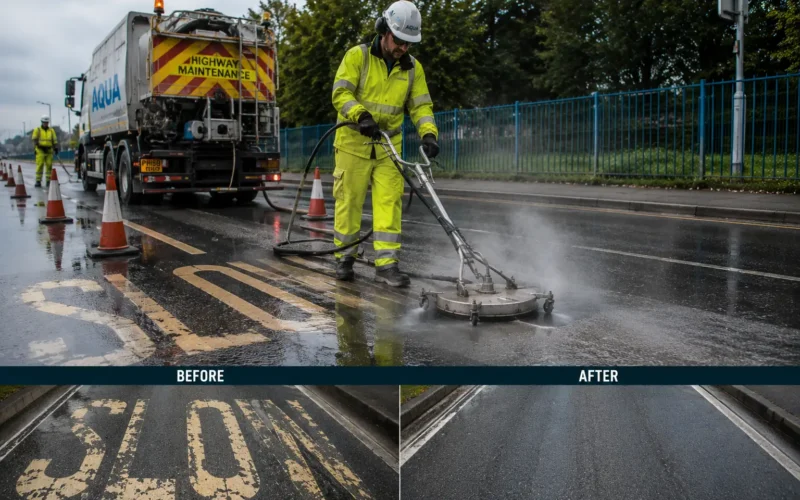
- Remove, do not overpaint. A new line over a failed one inherits its failure. See line marking removal.
Warranty and inspection
We inspect our thermoplastic and MMA markings before handover and record what was applied, so if a line fails early the cause can be identified — and in our experience it can almost always be traced to the surface, the traffic or the specification, all of which are visible on the site visit before we quote. That visit is free, and it is the best predictor of how long the line will last.
A maintenance plan that works
For a facility or a compound, the practical plan has three parts. Inspect annually, ideally after the summer, walking the site at night as well as by day: note lines that are worn through, symbols that are illegible, studs that are missing and areas where dust has dulled reflectivity. Refresh on a schedule: painted car parks and internal roads on a two- to three-year cycle depending on use, with entrances and arrows refreshed more often; thermoplastic on public-type roads when the night-time inspection shows it, typically after several years. Fix the cause, not the symptom: if a line has failed early, find out why before re-marking — a surface problem will fail the new line too. On public roads the equivalent is the authority’s retro-reflectivity survey, which triggers renewal when readings fall below the maintenance threshold.
What a handover record tells you later
An application record — material, batch, temperature, thickness, bead rate, date, weather — is the document that makes a failure explainable. With it, the cause is usually obvious within a minute: the line was applied at the specified thickness onto a surface that was later found to be contaminated, or it was applied thin, or without beads. Without it, the argument goes on for months. Ask for the record at handover and keep it with the drawings.
Frequently asked questions
How long does thermoplastic road marking last in Qatar?
Several years on busy roads and many years on lightly trafficked ones, with life ending when the profile wears down or night-time retro-reflectivity drops below the maintenance threshold. Surface preparation, thickness, bead loading and traffic decide where in that range a line falls.
How long does painted road marking last?
Months to about a year on busy roads where tyres cross the line; one to three years on lightly used car parks and internal roads. Paint is refreshed on a maintenance cycle rather than expected to last.
Does the heat destroy road markings?
Heat and UV degrade cheap paints and pigments and can soften thermoplastic slightly, but the main killer in Qatar is sand abrasion by tyres. Hot-climate formulations and correct preparation make the biggest difference.
Why did our new road marking fail within months?
Almost always the surface: dust, oil, moisture, uncured asphalt, polished asphalt or unprimed concrete under the line. Occasionally the wrong material for the traffic, or thickness and beads below specification.
When should road markings be renewed?
On public roads, when retro-reflectivity measured at night falls below the specified threshold; on private sites, when lines are no longer clearly legible. Annual inspection catches it before drivers do.
Get a free site visit and a same-day quotation
Send us the location, the approximate area or number of bays and any drawings you have. A UniGulf engineer will survey the site, confirm the material specification and send an itemised quotation — usually the same working day.