
Every layout change starts with a removal decision, and the wrong one leaves ghost lines that drivers follow for years. There are three ways to deal with an old road marking: blast it off with water, grind it off, or paint over it in black. Two of those are removal methods; the third is a way of postponing the problem. This article compares them on surface impact, cost, speed and suitability, so the method can be specified rather than left to whoever turns up. For the service, see line marking removal in Qatar.
Why removal matters more than it seems
Drivers read road markings faster than they read signs, and they read old markings as well as new ones. A lane line that has been blacked out is still visible at night when the blackout paint has worn to a different sheen from the asphalt; a car park bay that has been painted over shows through the new layout within months. On a public road the result is confusion at exactly the places — junction remodels, lane additions, diversions — where confusion is dangerous; in a car park it is complaints and bumps. Proper removal takes the old marking off the surface so the new layout is the only one there.
Method 1: High-pressure water-blasting
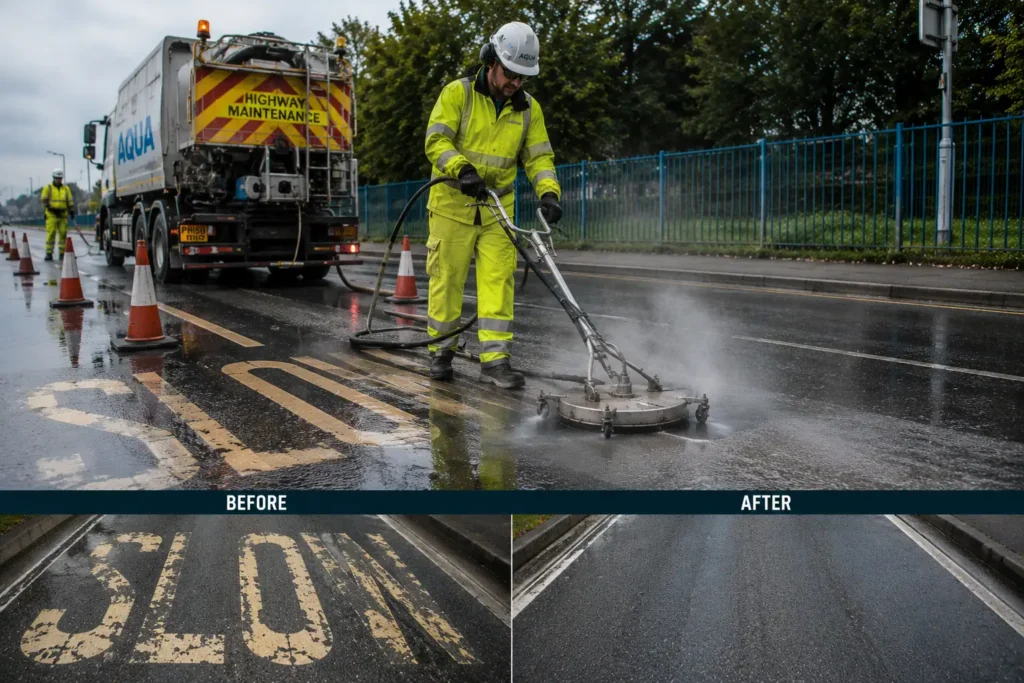
How it works. An ultra-high-pressure water jet — thousands of bar — is passed over the marking from a truck- or trailer-mounted unit with a rotating head, breaking the marking off the surface; a vacuum recovery system collects the water and debris.
Surface impact. Lowest of the three. With pressure and traverse speed matched to the surface, water-blasting lifts thermoplastic, paint and MMA with minimal scarring of the asphalt or concrete beneath. It is the method used on public roads and airport pavements for that reason.
Speed and cost. Moderate speed; higher unit cost than grinding because of the equipment, but no dust and less surface damage. Thick thermoplastic and MMA take more passes than paint.
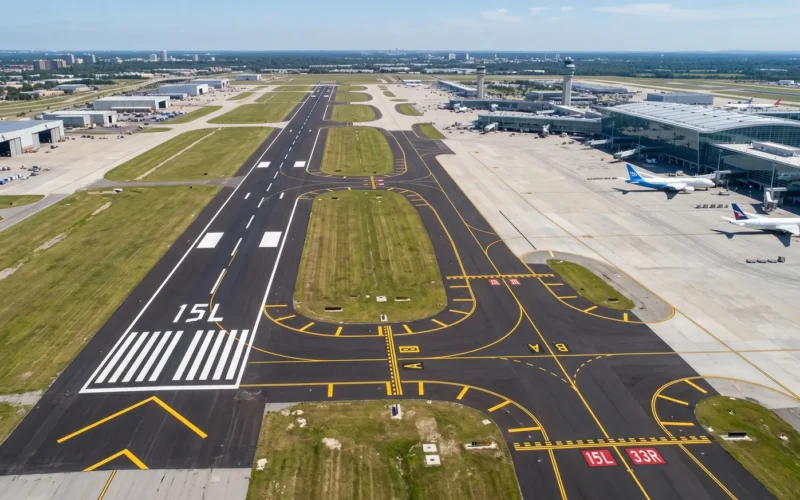
Use it for. Public roads, junction remodels, resurfaced roads with temporary lines, airport rubber and marking removal, any surface that must look untouched afterwards.
Method 2: Grinding and scarifying
How it works. A rotary head with carbide cutters or a scarifying drum abrades the marking off the surface; a diamond grinder is used on concrete. Dust is controlled by vacuum extraction.
Surface impact. Visible. Grinding removes a thin layer of the surface with the marking, leaving a lighter, textured strip where the line was. On asphalt that strip weathers in over time; on concrete it is permanent. It is therefore chosen where a texture change is acceptable or where the surface will be resurfaced or coated afterwards.
Speed and cost. Fast on thick material and on concrete; lower unit cost than water-blasting; generates dust and noise.
Use it for. Car parks and warehouse floors being re-planned, thick thermoplastic on surfaces to be resurfaced, concrete decks that will receive an epoxy floor (where shot-blasting, a related method, gives a uniform profile), and industrial sites where appearance is secondary.
Method 3: Overpainting (blackout)
How it works. Black paint is applied over the old marking to hide it.
Surface impact. None to the surface — but the old marking is still there, under a film that wears at a different rate from the surrounding asphalt. Within months the blackout has a different sheen, then it wears through, and the old line reappears; at night under headlights the difference can be visible from the start. On concrete the black rectangle is permanent.
Speed and cost. Fastest and cheapest on the day; the most expensive over the life of the layout, because it is redone and eventually removed properly anyway.
Use it for. Very short-term temporary situations where the layout will change again within weeks and the road will be resurfaced. Not for public roads, and not under a new car park layout.
Comparison
| Criterion | Water-blasting | Grinding | Overpainting |
|---|---|---|---|
| Removes the marking? | Yes | Yes | No — hides it |
| Surface impact | Minimal | Visible texture change | None, but ghost line returns |
| Thermoplastic / MMA | Good, more passes | Fast | Poor — raised profile still visible |
| Paint | Good | Good | Poor |
| Dust / water | Water, recovered | Dust, extracted | None |
| Cost per metre | Higher | Lower | Lowest (then repeated) |
| Best for | Public roads, airports, visible surfaces | Car parks, floors, surfaces to be coated | Short-term temporary only |
Choosing the method
- What is the surface? Asphalt on a public road or an airport pavement: water-blast. Concrete deck to be coated: grind or shot-blast. Car park asphalt to be re-marked: either, depending on appearance.
- What is the marking? Thick thermoplastic and MMA remove faster by grinding; paint by either.
- Does the surface have to look untouched? If yes, water-blast.
- What happens next? If the surface is being resurfaced or coated, grinding is fine. If it is being re-marked and left, water-blasting keeps the surface uniform.
- Is it temporary? Only then consider blackout, and plan the proper removal.
Sequencing removal with re-marking
Removal and re-marking are best quoted and scheduled together: the surface is removed, swept and dried and the new layout applied in the same shift, so a live road or car park is never left without markings overnight. On highways this happens inside a lane closure at night; in car parks, section by section. Our thermoplastic and car park marking crews carry the removal equipment for exactly this reason. Read how long markings last to plan the next cycle.
A worked example: a resurfaced arterial road with temporary lines
A resurfaced arterial had been opened with temporary painted lines while the permanent thermoplastic layout was finalised. The permanent layout added a lane at one junction, so about a third of the temporary lines were in the wrong place. Blacking them out was proposed to save a night; we advised against it, because the blacked-out lines would have been visible at night from the day the road opened. Instead the temporary paint was water-blasted off inside a lane closure — quick, because thin paint on new asphalt lifts easily — and the permanent thermoplastic was laid on the swept, dry surface the same night. Two nights, no ghost lines, and the new lane read correctly from the first morning. The alternative would have produced complaints within the first week and a proper removal a year later at the same cost plus a closure.
Specifying removal
- State the method: high-pressure water-blasting with vacuum recovery, or grinding, or shot-blasting for surfaces to be coated.
- State the material to be removed and its approximate thickness, so passes can be priced.
- State the acceptable surface condition afterwards — “no visible scarring” for public roads.
- Require debris containment, collection and disposal, and a swept surface ready for re-marking.
- Prohibit blackout overpainting on public roads and under new car park layouts.
Frequently asked questions
What is the best way to remove road markings?
High-pressure water-blasting with vacuum recovery for public roads and airport pavements, because it removes the marking with minimal damage to the surface. Grinding is faster on thick material and concrete but leaves a visible texture, so it suits car parks and surfaces that will be coated.
Can you just paint over old lines with black paint?
Only as a very short-term measure. Blackout paint wears at a different rate from the asphalt, the old line reappears as a ghost marking — often visible at night from the start — and the marking still has to be removed properly later.
Does grinding damage the road?
It removes a thin layer of surface with the marking, leaving a lighter textured strip. On asphalt it weathers in; on concrete it is permanent. Choose grinding where that is acceptable or the surface will be coated or resurfaced.
Can thermoplastic and MMA markings be removed?
Yes, by water-blasting or grinding. Both take more passes than paint and are priced accordingly.
How soon can new markings go down after removal?
As soon as the surface is dry and swept — often the same shift. Removal and re-marking are scheduled together so a road or car park is never left blank overnight.
Get a free site visit and a same-day quotation
Send us the location, the approximate area or number of bays and any drawings you have. A UniGulf engineer will survey the site, confirm the material specification and send an itemised quotation — usually the same working day.